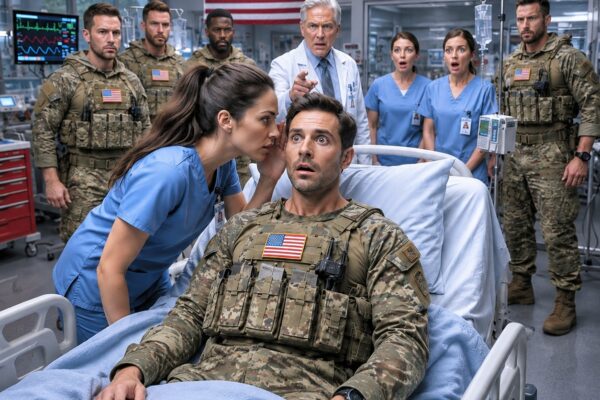
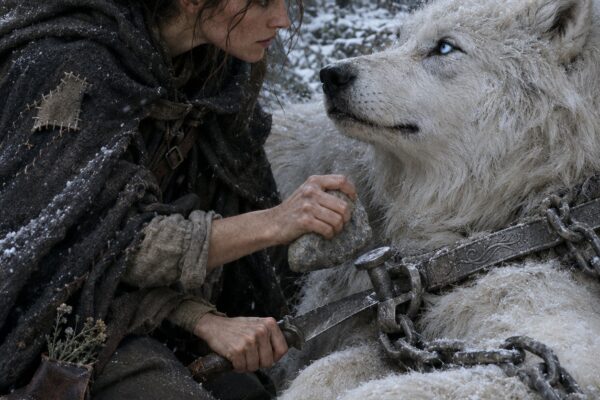
A Navy SEAL Carried His Dying Military Dog Into a California Hospital, but When the Hospital Fired the Only Nurse Who Could Save Him, the Commander Made a Decision That Brought Police to the Doors, Exposed a Million-Dollar Scandal, and Forced Everyone to Discover What Loyalty Really Meant
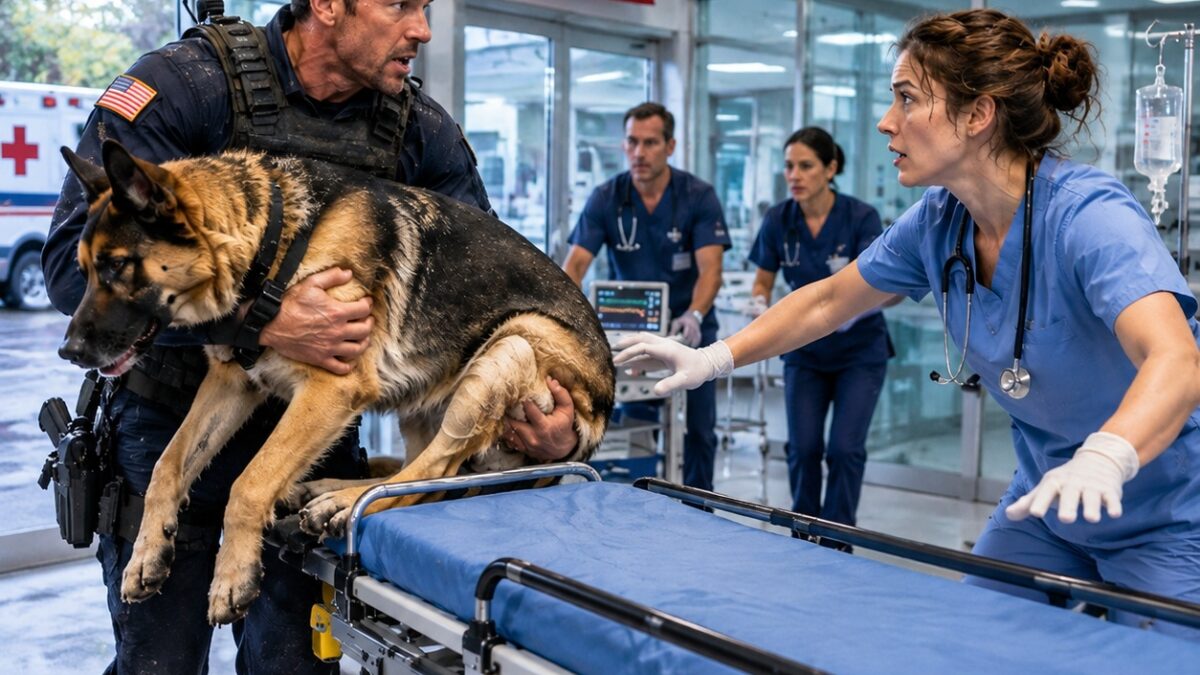
A Navy SEAL Carried His Dying Military Dog Into a California Hospital, but When the Hospital Fired the Only Nurse Who Could Save Him, the Commander Made a Decision That Brought Police to the Doors, Exposed a Million-Dollar Scandal, and Forced Everyone to Discover What Loyalty Really Meant
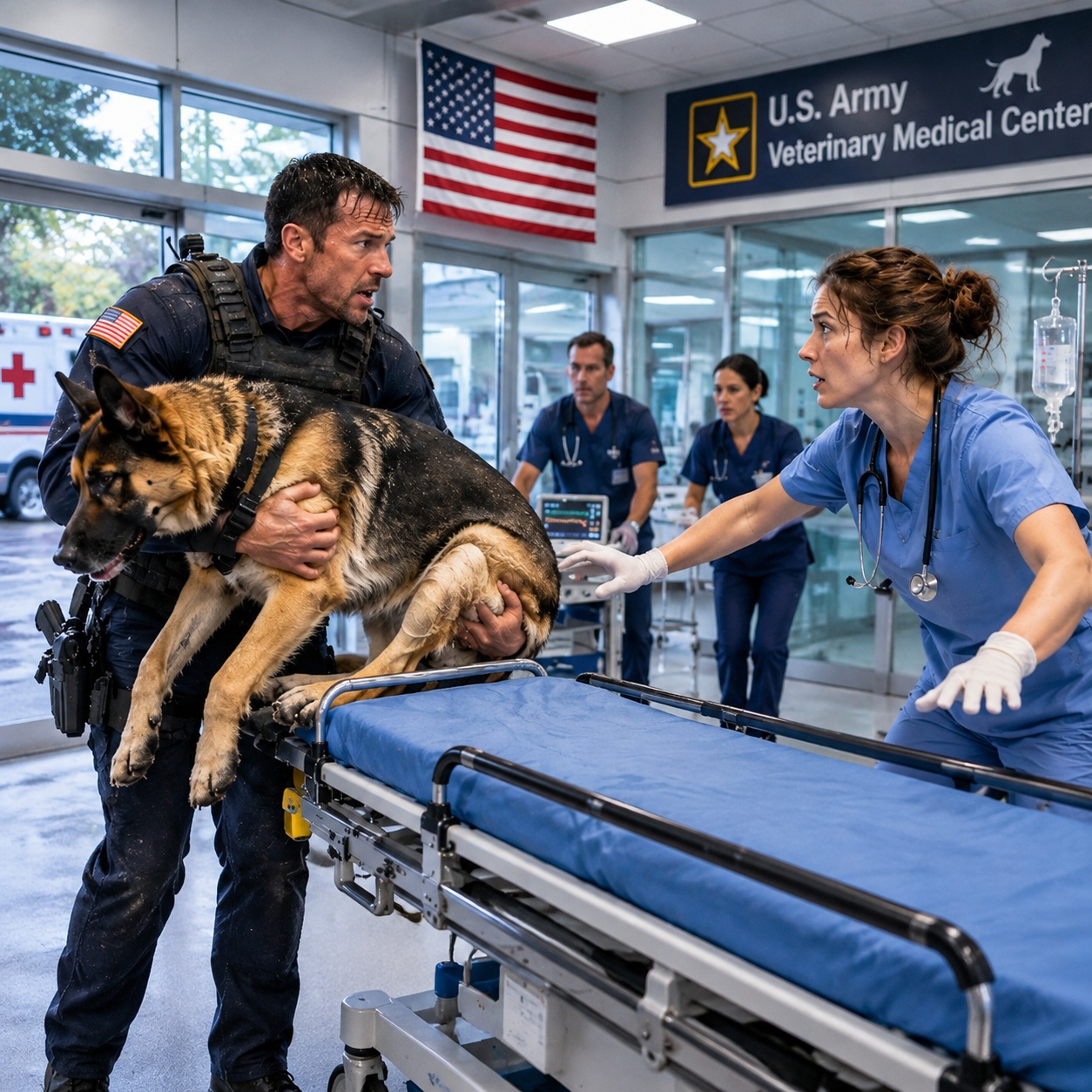
The Navy SEAL came running through the emergency entrance with a dying German Shepherd in his arms.
He was soaked from the rain, covered in dirt, and shouting for someone to save his dog.
But the hospital administrator had a different concern.
The treatment was too expensive.
And the nurse who refused to let the dog die because of a budget decision was about to lose her job.
My name is Kara Mitchell. I was twenty-nine years old, a veterinary critical-care nurse at Pacific Coast Veterinary Medical Center near Coronado, California.
I had worked with injured military working dogs for almost seven years.
I knew what they could endure, how they communicated pain, and how difficult it could be for them to recover when their bodies were injured but their minds were still fighting a battle.
But I had never met a dog like Titan.
He weighed nearly ninety pounds and had served alongside Navy SEAL Commander Daniel Mercer for six years.
During a classified training exercise near the Southern California coastline, an explosive device detonated unexpectedly.
Titan had detected the danger seconds before the blast.
He moved between Mercer and the explosion, shielding his handler and several other operators.
The blast shattered his pelvis, damaged both hind legs, and sent fragments of metal into his body.
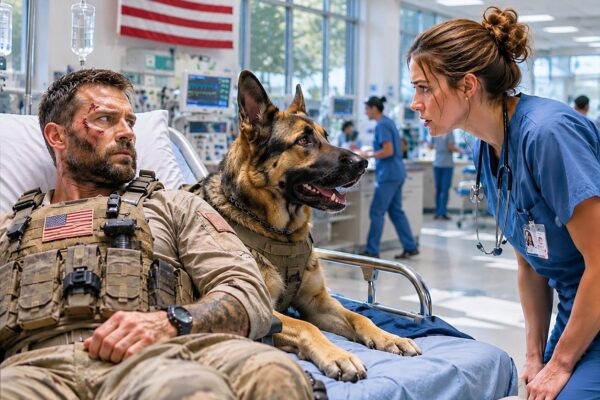
When Mercer carried him into our emergency department, Titan was barely breathing.
“Please,” Mercer said, his voice breaking. “Don’t let him die.”
I didn’t waste a second.
“Get me a trauma table! Dr. Reynolds, I need you now!”
We rushed Titan into surgery.
For six hours, our surgical team worked to stabilize his pelvis, remove fragments, and repair the worst injuries.
When the operation ended, Dr. Michael Reynolds came out looking exhausted.
“We’ve stopped the bleeding,” he told Mercer. “But the next few days will determine whether he survives.”
Mercer stood perfectly still.
“Can I see him?”
Dr. Reynolds nodded.
The commander entered the intensive-care unit and approached Titan’s enclosure.
He placed one hand against the glass.
“Come on, buddy,” he whispered. “You didn’t save all those men just to quit on me now.”
I watched him for a moment.
Then I noticed something unusual.
Titan’s heart rate began to climb whenever unfamiliar people approached his enclosure.
His breathing became irregular.
He refused food and resisted almost every attempt to change his dressings.
But whenever I entered, he watched me carefully.
I never approached him with exaggerated affection or a high-pitched voice.
I spoke calmly, moved slowly, and gave him time to understand what I was doing.
I started sitting beside his enclosure after my shifts ended.
Sometimes I read medical reports aloud.
Sometimes I simply talked about ordinary things.
I hand-fed him nutritional paste when he refused his meals.
I learned exactly where he allowed me to touch him and which movements made him nervous.
Gradually, he began accepting treatment.
His heart rate became more stable.
His wounds started healing.
Even Dr. Reynolds admitted that Titan was responding better than anyone had expected.
One evening, Mercer stood beside me as I adjusted Titan’s bandages.
“You have a way with him,” he said.
“He knows I’m not trying to hurt him.”
Mercer looked at his dog.
“He’s saved six men during his career. Six. And the only thing he’s ever asked for in return is to know that his people are still there.”
I glanced at him.
“Then we’ll make sure he knows.”
For a moment, the commander smiled.
I thought we were finally going to save Titan.
I was wrong.
Our hospital had recently been purchased by a private investment group.
The new administration had introduced strict spending limits, reduced staffing, and demanded approval for nearly every expensive medical supply.
The man responsible for enforcing those policies was Richard Caldwell, our newly appointed hospital administrator.
He viewed every patient as a financial calculation.
And Titan was becoming an expensive one.
On Friday morning, Caldwell summoned me to his office.
He placed a stack of invoices on his desk.
“Miss Mitchell, you’ve recorded twenty-three hours of unauthorized overtime this week.”
“I’ve been providing necessary postoperative care.”
“You’ve also been using premium silver-alginate dressings instead of the standard gauze approved by our billing department.”
“Standard gauze sticks to Titan’s damaged tissue. Every time we remove it, we risk reopening the surgical wounds.”
“He’s a dog, Miss Mitchell. This is a business.”
I stared at him.
“He’s a military working dog who saved American service members. His wounds require specialized treatment.”
“His insurance authorization has a limit.”
“His medical needs don’t disappear when the budget runs out.”
Caldwell leaned back.
“Your emotional attachment is interfering with your judgment.”
I felt my hands tighten.
“Then perhaps you should come downstairs and explain to Dr. Reynolds why you’re asking him to use materials that could damage a patient’s surgical wounds.”
His expression hardened.
“You’re terminated, effective immediately.”
I thought I had misunderstood him.
“Excuse me?”
“Security will escort you out. Your access badge is being deactivated.”
I stood up.
“You cannot remove me from Titan’s care. He barely tolerates anyone else.”
“We have qualified employees.”
“Then why hasn’t he allowed anyone else to change his dressings?”
Caldwell didn’t answer.
Within fifteen minutes, security escorted me through the rear entrance.
I stood in the parking lot, holding my belongings in a cardboard box while the California rain soaked my uniform.
Then I heard something.
A long, heartbreaking howl came from the intensive-care unit.
Titan knew I was gone.
The deterioration began almost immediately.
Without my presence, he became increasingly distressed.
A young technician attempted to administer his medication.
Titan snapped at the equipment tray, causing it to crash against the floor.
The noise triggered a severe panic response.
He stopped drinking.
He pulled at his surgical dressing and damaged several stitches.
By Saturday morning, his temperature had risen dangerously, and his heart rhythm had become unstable.
Dr. Reynolds warned Caldwell that Titan was developing a potentially fatal stress-related cardiac complication.
“We need Kara back,” he insisted. “She’s the only person he consistently accepts.”
Caldwell refused.
“Sedate him. If he remains dangerous, arrange a transfer to the municipal facility.”
“He’s too unstable to survive transportation!”
“Then find another solution.”
That afternoon, Commander Mercer returned from his military assignment.
He expected to find Titan recovering.
Instead, he found an injured dog trembling in the corner of his enclosure, blood on the floor, alarms sounding, and frightened technicians standing outside.
Mercer looked at Dr. Reynolds.
“Where’s Kara?”
Nobody answered.
Finally, the doctor explained everything.
Mercer slowly turned toward Caldwell.
“Are you telling me you fired the only person who could keep my dog alive?”
“Commander, this is a private medical facility. We have policies.”
Mercer’s expression changed.
He removed his tactical belt and placed it on the counter.
Then he looked directly at Caldwell.
“You’re going to make one phone call.”
“To whom?”
“To Kara Mitchell.”
Caldwell shook his head.
“That’s not going to happen.”
Mercer stepped toward the intensive-care doors.
And what he did next would bring the entire San Diego Police Department to our hospital.
PART 2 — THE COMMANDER’S LAST STAND
Mercer ordered everyone except Caldwell to leave the intensive-care unit.
Dr. Reynolds tried to explain that the dog needed immediate medical attention, but Mercer raised one hand.
“I’m not here to hurt anyone, Doctor. I’m here to make sure nobody makes this worse.”
He moved between Titan’s enclosure and the administrator.
Then he secured the unit’s doors with temporary restraints he carried in his equipment bag and moved a heavy metal table in front of the entrance.
It wasn’t a military operation.
It was a desperate, dangerous attempt to buy his dog enough time.
Caldwell stared at him.
“Have you lost your mind? You’re holding me against my will!”
“Then call the police.”
“I’m going to have you arrested!”
“Call them.”
Mercer pulled a chair beside Titan’s enclosure and sat down.
“Nobody touches this dog until Kara gets here.”
Outside, hospital employees were already calling security.
Within minutes, police vehicles arrived.
The first officer to approach the intensive-care unit was Captain Thomas Walker, a former Marine who had served two deployments before joining the San Diego Police Department.
He looked through the glass.
Inside, he saw an exhausted SEAL commander sitting beside a badly injured military dog.
A frightened administrator stood several feet away.
Walker immediately realized this wasn’t an ordinary hostage situation.
He requested a negotiator and ordered his officers not to force entry.
“Commander Mercer,” he called through the glass. “I’m Captain Walker. We need to talk.”
Mercer looked up.
“Then listen.”
“Nobody wants anyone hurt.”
“Good. Then bring Kara Mitchell here.”
“Is she the dog’s veterinarian?”
“She’s the only nurse who understands him. She knows how to treat him without triggering another panic response.”
Walker glanced at Titan.
The dog’s breathing was shallow.
His ears moved whenever someone approached.
The commander continued.
“He saved six men during an explosion. He took injuries that would have killed most animals. He never abandoned his team. I’m not abandoning him because someone decided his treatment was too expensive.”
Walker lowered his radio.
“Let me see what I can do.”
Meanwhile, a technician had recorded the confrontation between Mercer and Caldwell on her phone.
The video reached a local television station before the evening news.
Within an hour, the story was everywhere.
NAVY SEAL REFUSES TO LEAVE HOSPITAL AFTER MILITARY DOG IS DENIED SPECIALIZED CARE.
Former service members began arriving outside the hospital.
Some carried American flags.
Others held photographs of their own retired military dogs.
A group of veterans from a local motorcycle organization organized a peaceful gathering near the entrance.
The hospital’s phone lines were overwhelmed.
But the person who needed to see the footage most was still sitting alone in her apartment.
I had spent the morning packing my nursing supplies into boxes.
I had no idea whether I would ever work with military dogs again.
My phone rang.
An unfamiliar number appeared.
“Hello?”
“Miss Mitchell? This is Captain Walker with the San Diego Police Department.”
My stomach tightened.
“Is Titan alive?”
There was a brief silence.
“Yes. But his condition is critical.”
I stood up so quickly that my chair fell backward.
“What happened?”
“The commander has secured himself inside the intensive-care unit. He refuses to leave until you’re brought back.”
I closed my eyes.
“Daniel?”
“Commander Mercer, yes.”
“Is he hurt?”
“No. But the situation is becoming increasingly serious.”
I grabbed my jacket.
“Tell him I’m coming.”
When I arrived, police officers were standing behind temporary barricades.
The crowd outside had grown considerably.
Captain Walker met me near the entrance.
“Miss Mitchell, before you go in, I need you to understand something. This situation is complicated.”
“I understand.”
“Commander Mercer may face serious consequences.”
I looked toward the building.
“Then let’s make sure Titan survives first.”
Walker nodded.
He escorted me toward the intensive-care unit.
Through the glass, I saw Mercer sitting beside Titan.
His shoulders were slumped.
His hands were clasped together.
For the first time since I had met him, he looked completely helpless.
When he noticed me, he stood.
I could see his lips move.
“Kara.”
Walker negotiated access for me and Dr. Reynolds.
The restraints were removed.
The doors opened.
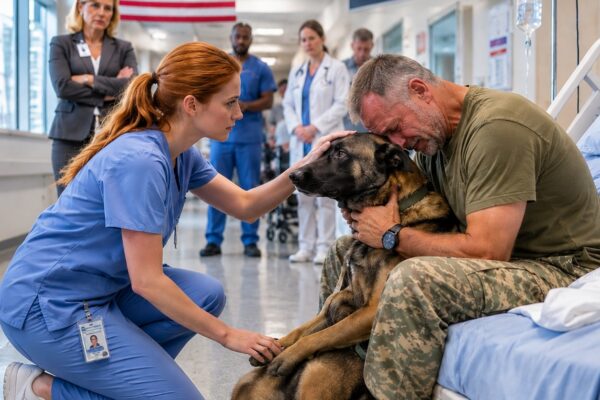
I ran straight toward Titan’s enclosure.
“Oh, my big boy.”
His head moved slightly.
I knelt beside him.
His eyes found mine.
I placed my hand against the metal bars and began humming the same quiet melody I had used during his first nights in intensive care.
“Easy, Titan. You’re safe. The operation is over. You’re home.”
His growl gradually faded.
He moved his nose toward my hand.
I opened the enclosure carefully and sat beside him.
I didn’t hug him immediately.
I let him recognize my voice, my scent, and my presence.
Then I felt his head settle against my leg.
I looked at Dr. Reynolds.
“We need to stabilize his heart rhythm and reassess his surgical wounds. Get the emergency cardiac medication ready.”
The doctor nodded.
For the next hour, the room became a medical emergency rather than a police standoff.
I worked beside Dr. Reynolds, administering the prescribed medication and helping restore Titan’s fluid balance.
I spoke to him continuously.
When his muscles finally began to relax, his breathing became more regular.
The heart monitor, which had been alarming everyone in the room, gradually returned to a steadier rhythm.
Then Dr. Reynolds looked at me.
“He’s responding.”
I exhaled.
“Good. Let’s keep it that way.”
Behind us, Mercer had lowered himself against the wall.
His face was buried in his hands.
The man who had faced combat without hesitation was crying because his dog had finally stopped suffering.
I walked over.
“He’s still with us, Commander.”
Mercer looked up.
“Thank you.”
“You don’t have to thank me. Just stay with him.”
The situation outside was still unresolved.
Captain Walker entered the unit and approached Mercer.
The commander immediately stood and extended his wrists.
“I understand the consequences. I’ll cooperate.”
Walker looked around.
The doors had been secured.
The administrator was unharmed.
The dog was receiving treatment.
Then he looked at Caldwell.
“Sir, I understand you are the hospital administrator.”
“Yes. I want this man arrested immediately.”
Walker opened his notebook.
“Before we discuss that, I want to understand why a medically necessary treatment plan was interrupted.”
Caldwell began explaining insurance limits, staff safety, and unauthorized expenses.
Walker listened without interrupting.
Then Dr. Reynolds handed him the medical documentation.
It showed that Titan’s specialized dressings had been recommended by the surgical team.
It also showed that the administrator had rejected requests for continued treatment despite explicit medical warnings.
There was something else.
The invoices revealed that the hospital had been charging the military for premium postoperative care while simultaneously instructing staff to use cheaper materials whenever possible.
Dr. Reynolds had already reported the discrepancy internally.
Nothing had been done.
Captain Walker made several calls.
Within an hour, the hospital’s corporate leadership became involved.
The chairman of the investment group that owned Pacific Coast Veterinary Medical Center, Arthur Bennett, was watching the television coverage from his Los Angeles office.
He called Caldwell.
The administrator answered immediately.
“Mr. Bennett, thank goodness. We have a serious security situation.”
Bennett’s response was furious.
“You fired a specialist treating a critically injured military working dog?”
“She violated our budget policies.”
“She was providing the care our own surgeon recommended!”
“Sir, I was following administrative directives.”
“Then you should have followed the medical directives first.”
Caldwell tried to respond.
Bennett cut him off.
“You’re no longer authorized to represent this hospital. Turn over your access credentials.”
The call ended.
Caldwell stood silently.
The same policies he had used to justify firing me had now destroyed his position.
But I wasn’t thinking about him.
I was watching Titan sleep.
The investigation continued for several weeks.
The hospital board reviewed its treatment policies, staffing decisions, and financial records.
Caldwell was formally dismissed.
The investment group agreed to fund an independent review of its military working-dog program.
More importantly, it created a dedicated rehabilitation fund for retired and injured service animals.
I was offered my position back.
I initially hesitated.
I didn’t want to return to a place where financial calculations had nearly cost a patient his life.
But Dr. Reynolds asked me to consider something.
“If you walk away, they’ll simply hire someone else and continue doing things the same way. If you stay, you can make sure the next Titan receives the care he deserves.”
I accepted.
Not because I trusted the company.
Because I trusted the work.
The board also offered me the position of director of military working-dog critical care, with authority over treatment protocols and specialized supplies.
I made one condition.
No administrator would ever again be allowed to override a veterinarian’s medical decision simply to save money.
They agreed.
Titan’s recovery took four difficult months.
There were setbacks.
An infection required another procedure.
His injured pelvis healed slowly.
He needed extensive physical rehabilitation before he could stand without assistance.
But he never fought me again.
Every morning, he recognized my footsteps.
Every evening, Mercer visited.
Sometimes the commander brought photographs from their deployments.
Other times, he simply sat beside the enclosure and talked.
One afternoon, while Titan was practicing walking with a support harness, Mercer approached me.
“Do you think he’ll ever run again?”
I watched Titan carefully place one paw forward.
“I don’t know. But I think he’ll walk.”
Mercer nodded.
“That’s enough.”
I smiled.
“For now.”
Four months after the explosion, the hospital held a small retirement ceremony.
There were no expensive decorations.
No corporate speeches about quarterly performance.
Just a group of military personnel, veterinary staff, and people who had followed Titan’s story.
Mercer arrived wearing his formal Navy uniform.
Beside him walked Titan.
The dog still had a slight limp.
A long scar crossed his hindquarters.
But his head was held high.
When they reached the entrance, Titan stopped and looked toward me.
I knelt.
“Well, look at you.”
He approached and gently pressed his nose against my shoulder.
I couldn’t hold back my tears.
Dr. Reynolds stood beside me.
“Looks like someone has a favorite nurse.”
I laughed.
“Don’t tell the others.”
Mercer stepped forward.
For a moment, he said nothing.
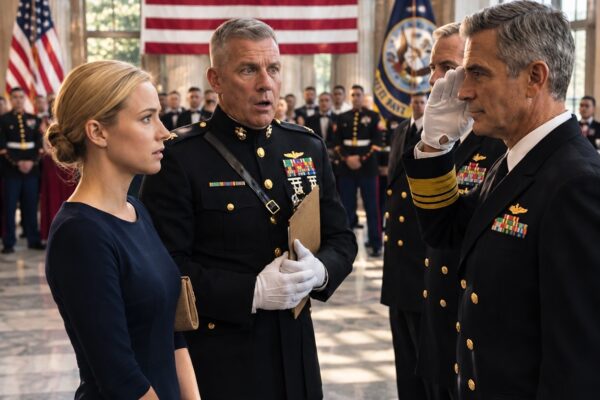
Then he stood straight, raised his hand, and gave me a military salute.
I froze.
“Commander, you don’t have to—”
“Yes, I do.”
His voice was steady.
“That dog saved my life and the lives of my men. When everyone else saw an expensive patient, you saw a life worth fighting for.”
He lowered his hand.
“You didn’t abandon him.”
I placed my hand over my heart.
“Neither did you.”
Titan gave a small bark.
Everyone laughed.
It was the first time I had heard him bark since the explosion.
And somehow, that sound meant more to me than the ceremony itself.
A year later, I still worked at Pacific Coast Veterinary Medical Center.
The hospital had changed.
Military working dogs received dedicated treatment plans, specialized rehabilitation, and access to medical supplies without unnecessary administrative delays.
Mercer occasionally visited with Titan.
The dog had been medically retired and was living with his handler.
He couldn’t return to active duty, but he had a new job.
He had become the unofficial guardian of Mercer’s home.
And, according to the commander, he had developed an unfortunate habit of stealing the best spot on the couch.
One afternoon, I received a photograph from Mercer.
It showed Titan lying on a sunny porch, his head resting on a large military boot.
On the back, Mercer had written:
He still remembers you. Every time I say your name, his ears move.
I placed the photograph on my desk.
Then I looked through the glass toward the rehabilitation area.
A young military working dog had just arrived with an injured paw.
His handler looked frightened.
I walked toward them.
“Hi. I’m Kara. Let’s take care of your partner.”
The handler nodded.
And as I knelt beside the dog, I remembered the night Titan arrived in Mercer’s arms.
I remembered the administrator who had called him an expense.
I remembered the police lights, the barricaded doors, and a commander who had been willing to sacrifice his career rather than abandon his closest partner.
Most of all, I remembered something Mercer had said during those first difficult days.
Titan had never left a man behind.
So his handler wasn’t going to leave him behind, either.
That was the lesson I carried into every shift afterward.
A hero doesn’t stop being a hero when the uniform comes off.
And loyalty doesn’t become less valuable simply because it costs more than someone expected.
Sometimes the greatest test of a hospital isn’t how advanced its machines are or how impressive its buildings look.
It’s what happens when saving a life becomes inconvenient.
Because when the doors closed around Titan, one nurse lost her job, one commander risked everything, and an entire community discovered that some things should never be measured in dollars.
Especially the life of someone who once gave everything to save yours.