THE NAVY SEAL DOG WHO HAD BEEN SENTENCED TO DEATH RAN STRAIGHT AT A QUIET JANITOR—BUT INSTEAD OF ATTACKING HER, HE DID SOMETHING THAT LEFT EVERY SOLDIER SPEECHLESS… AND SAVED A LIFE NO ONE KNEW WAS IN DANGER
THE NAVY SEAL DOG WHO HAD BEEN SENTENCED TO DEATH RAN STRAIGHT AT A QUIET JANITOR—BUT INSTEAD OF ATTACKING HER, HE DID SOMETHING THAT LEFT EVERY SOLDIER SPEECHLESS… AND SAVED A LIFE NO ONE KNEW WAS IN DANGER
The military had already signed the papers to put the most dangerous dog in its K-9 program to sleep.
Three experienced handlers had been injured trying to work with him. His former handler was dead, and the once-celebrated Belgian Malinois had become so unpredictable that nobody dared enter his kennel without protective equipment.
But just three days before his scheduled euthanasia, a quiet janitor walked into the training yard carrying a broom.
And when the dog saw her, something happened that would change both their lives forever.
My name is Melissa Hayes. I was twenty-eight years old, and at the time, I worked as a civilian maintenance assistant at a military canine rehabilitation facility in rural Pennsylvania.
I wasn’t a soldier. I wasn’t a veterinarian. I had never handled an attack dog.
I was simply a woman trying to earn enough money to pay rent and survive a life that had become considerably harder than I had expected.
The dog’s name was Koda.
He was a forty-kilogram Belgian Malinois who had served four years alongside Navy SEAL handler Chief Petty Officer Ryan Mitchell in Afghanistan.
Together, they had searched abandoned buildings, located buried explosives, and protected American soldiers during some of the most dangerous operations of their deployment.
Koda was exceptional.
He could detect explosives hidden beneath packed earth, identify suspicious movement in darkness, and follow commands even when gunfire erupted around him.
His military record included dozens of successful missions.
But his greatest achievement had come during an ambush in Helmand Province.
Ryan had been seriously wounded when their convoy came under enemy fire.
Koda refused to leave him.
He positioned himself over Ryan’s body, taking shrapnel wounds to his shoulder and side while keeping approaching attackers away until the rescue helicopter arrived.
Unfortunately, Ryan died during the evacuation.
Koda returned to America without the man who had been his entire world.
Veterinarians repaired his physical injuries, but nobody could repair what had happened inside his mind.
He developed severe trauma-related behavioral problems.
Sudden noises sent him into uncontrollable defensive reactions. Helicopter engines made him tremble. Even the sound of a metal door slamming could send him crashing against the walls of his enclosure.
The military assigned him to Master Sergeant Walter Miller, one of its most experienced canine rehabilitation specialists.
Walter had successfully rehabilitated dozens of military dogs.
He lasted three days with Koda.
The Malinois attacked him so suddenly that Walter required emergency surgery for injuries to his arm.
Two additional handlers were injured during subsequent attempts.
After that, Koda was classified as a high-risk military working dog.
He was transferred into a reinforced isolation kennel.
His days became an endless cycle of pacing, growling, and staring through the metal fencing.
The medical team tried different rehabilitation techniques.
Nothing worked.
Eventually, Captain Lucas Bennett, commander of the military working-dog division, signed the euthanasia authorization.
The procedure was scheduled for Friday morning.
But Dr. Andrew Collins, a civilian veterinary behavior specialist contracted by the Department of Defense, refused to accept the decision.
He had studied the security recordings of Koda’s attacks.
Other people saw a dangerous animal.
Andrew saw something different.
He saw a traumatized soldier trapped in a body that no longer understood the difference between a battlefield and a peaceful afternoon.
“Give me thirty days,” Andrew told Captain Bennett.
The captain folded his arms.
“That dog has already sent three men to the hospital.”
“Then give him thirty days somewhere that doesn’t remind him of Afghanistan.”
“And if he attacks someone?”
“I’ll accept responsibility.”
Captain Bennett stared at him for a long moment.
Finally, he agreed to a temporary transfer to a secured rehabilitation property in Pennsylvania.
Koda arrived heavily restrained.
Even after the sedatives began wearing off, he continued throwing himself against the reinforced enclosure.
The staff were instructed never to approach him without a trained handler.
For the first two weeks, he barely allowed Andrew within fifteen feet of the fence.
He ate only at night.
He slept in short bursts and woke growling.
Andrew began to fear that the thirty-day promise would end in failure.
Meanwhile, I continued doing my ordinary job.
I cleaned the administrative offices, swept the outdoor walkways, restocked cleaning supplies, and occasionally helped organize equipment in the storage building.
I knew about Koda.
Everyone did.
The staff called him the demon of Kennel Four.
I had never seen him up close, and I had no intention of changing that.
I also had a secret of my own.
For approximately six months, I had been experiencing terrible headaches.
Sometimes the pain started behind my left eye.
Sometimes I tasted something metallic in my mouth.
Occasionally, the entire room seemed to tilt, forcing me to grab a wall or sit down.
I had visited a low-cost clinic twice.
Both times, the doctors suggested stress, dehydration, and migraines.
I couldn’t afford expensive neurological testing.
So I took over-the-counter pain medication and continued working.
I was a single woman with rent to pay.
Taking time off wasn’t an option.
Then came Tuesday morning, the eighteenth day of Koda’s rehabilitation.
Andrew had decided to move him from isolation into a larger exercise enclosure.
Walter Miller had flown in to assist.
They secured Koda using specialized equipment and two heavy-duty leads.
Everything appeared to be going according to plan.
Until a sudden gust of wind slammed a metal storage door.
The sound echoed across the yard like a gunshot.
Koda exploded into action.
He twisted violently, breaking one of the metal connectors and pulling free of his restraint.
“CODE RED! THE DOG IS LOOSE!” Andrew shouted.
A young handler had just stepped outside the staff break room.
Koda charged him.
The man fell backward, throwing his arms over his face.
Koda pinned him to the ground, snarling inches from his head.
Walter raised his tranquilizer equipment, but the dog was moving too quickly for a safe shot.
Then Koda suddenly released the young man.
His ears turned toward the opposite side of the yard.
Fifty yards away, I had just stepped out of the maintenance shed.
I was holding a broom.
My head was pounding so badly that the sunlight seemed to break into bright fragments.
I rubbed my left temple and took an unsteady step onto the gravel.
I had no idea what was happening behind me.
I didn’t hear Andrew shouting.
I didn’t understand why the entire yard had suddenly gone silent.
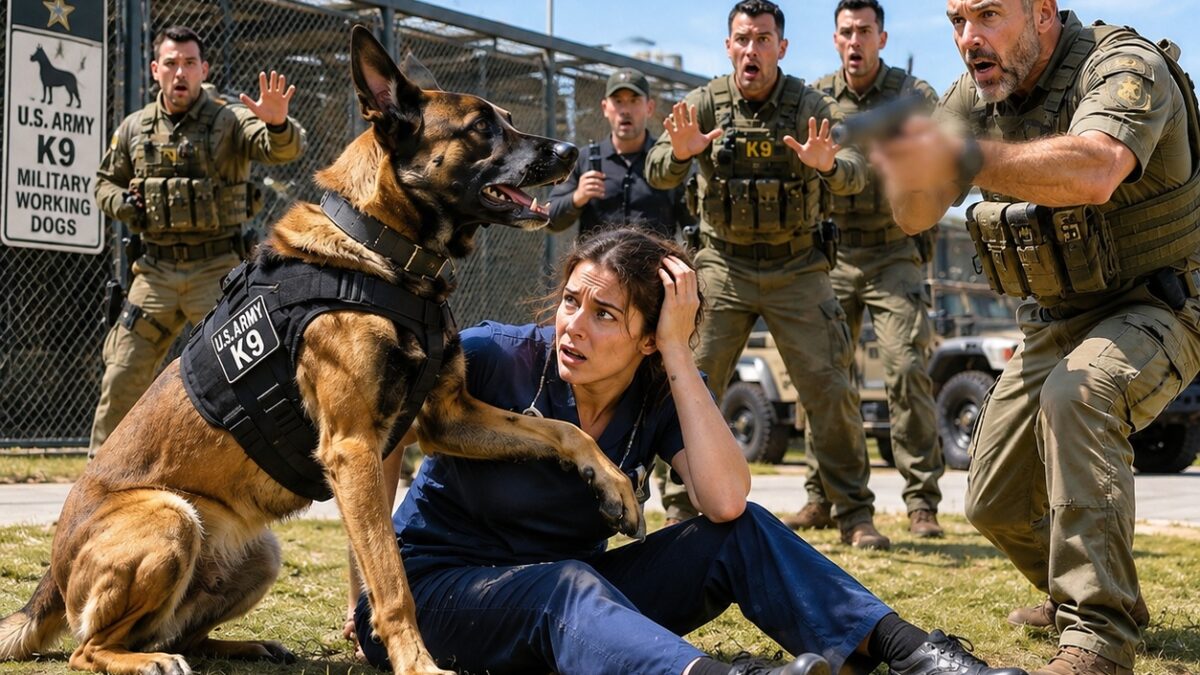
I only noticed a massive dog running directly toward me.
“KODA! NO!” Walter screamed.
Andrew reached for his radio.
The young handler was still lying on the ground.
Everyone expected the attack.
Koda crossed the remaining distance in seconds.
I tried to move, but a sudden wave of pain tore through my head.
My knees buckled.
The broom slipped from my hands.
I closed my eyes, waiting for teeth and claws.
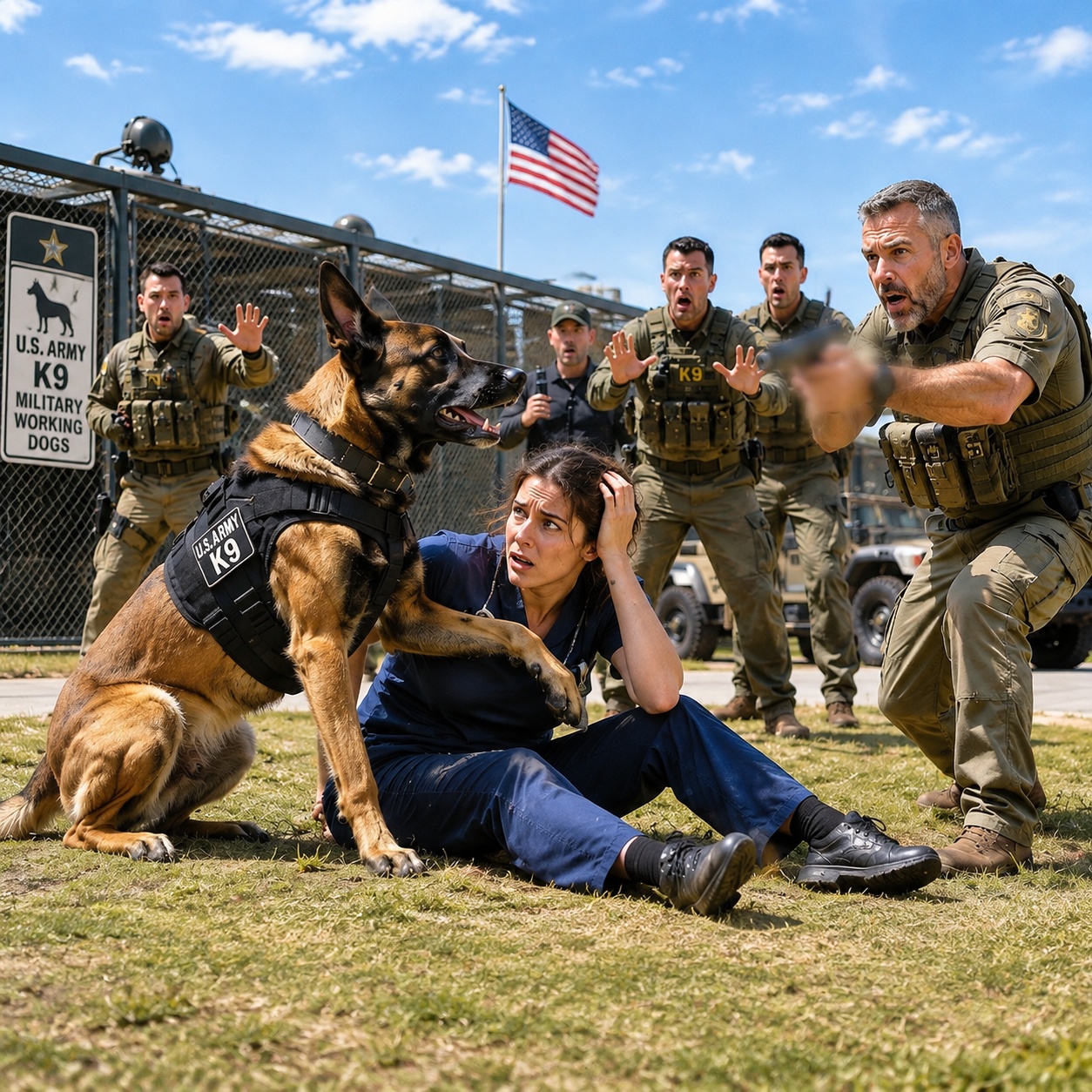
But Koda didn’t bite.
Instead, he slammed his body against my legs, knocking me backward onto the soft grass.
Before I could understand what had happened, the enormous dog positioned himself over me.
His muzzle pressed against my chest.
His back settled firmly against my side.
Then he turned his head toward the people running toward us.
A deep warning growl came from his throat.
Walter stopped dead.
Andrew lowered his hands.
Because the dog they had spent eighteen days trying to control wasn’t displaying the behavior of an attacking animal.
He was performing a military protection maneuver.
And then I lost consciousness.
But what happened next would reveal that Koda had detected something hidden inside my body that even two doctors had failed to discover.
PART 2 — THE SECRET KODA SMELLED BEFORE THE DOCTORS DID
I don’t remember falling unconscious.
I remember the sunlight.
I remember the strange metallic taste in my mouth.
And I remember a heavy warmth against my chest, as though someone had placed a thick blanket over me.
Then everything disappeared.
According to Andrew, my body began convulsing shortly after I collapsed.
Koda immediately shifted his position.
He pressed his chest against my upper body, keeping himself between me and the approaching staff.
Whenever someone tried to get closer, he growled.
Walter had spent twenty years working with military dogs.
He recognized the posture immediately.
“He’s not attacking her,” he whispered.
Andrew looked at him.
“Then what is he doing?”
“He’s protecting a downed person. It’s a priority-one defensive position.”
Walter had trained military dogs to guard injured handlers until help arrived.
But Koda had never demonstrated this behavior since returning from Afghanistan.
The dog everyone believed had forgotten every command was now following an instinctive protection protocol.
Andrew slowly approached.
Koda showed his teeth.
“Easy, buddy,” Andrew said. “Nobody is going to hurt her.”
He lowered himself onto one knee and carefully placed his hands where Koda could see them.
Then he noticed something.
Koda wasn’t looking at his face.
The dog’s nose kept returning to the left side of my head.
He sniffed near my temple, whined, and pressed his muzzle against my cheek.
“Something is wrong with her,” Andrew said.
He immediately called emergency services.
The ambulance arrived several minutes later.
Two paramedics, Brian Foster and Emily Ross, stepped out carrying oxygen equipment and a medical bag.
When they saw Koda, they stopped.
“Sir, we need access to the patient,” Brian said.
Walter raised one hand.
“Don’t rush him. He’s protecting her.”
“She’s having a seizure. We need to assess her airway.”
“I know. But if you approach too quickly, he may attack.”
Walter looked back at the dog.
Then he remembered something.
Ryan Mitchell, Koda’s former handler, had used a particular sequence of hand signals during their missions.
Walter slowly tapped his chest twice.
Then he pointed toward the ground.
“Stand down, Koda. Good boy. Your mission is complete.”
For several seconds, nothing happened.
Koda remained rigid.
Then I made a faint sound.
My fingers moved against the grass.
The dog immediately lowered his head.
I barely managed to whisper.
“It’s okay…”
Those two words changed everything.
Koda released a long, exhausted breath.
He stepped backward, sat beside my head, and barked once.
Walter nodded toward the paramedics.
“Now.”
They rushed forward, checked my breathing, administered oxygen, and prepared me for transport.
Koda remained beside the stretcher.
When the paramedics tried to close the ambulance doors without him, the dog became visibly distressed.
Andrew intervened.
“Let him come. He’s keeping her calm.”
After obtaining the necessary authorization, they allowed Koda to ride in the rear compartment under Walter’s supervision.
The dog curled beneath the stretcher, his eyes fixed on my face.
He didn’t growl once.
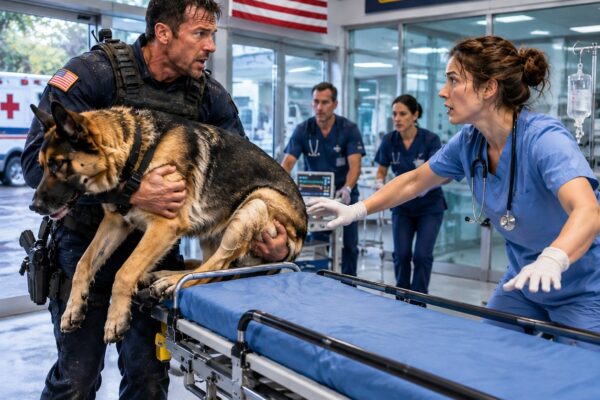
At Pennsylvania Memorial Hospital, I was rushed into the emergency department.
Dr. Samuel Reed, the attending neurologist, ordered an urgent CT scan followed by an MRI.
Andrew and Walter waited outside.
Koda sat beside the treatment-room entrance.
He refused food.
He refused water.
Every time a nurse walked through the doors, his ears lifted.
Almost an hour later, Dr. Reed emerged.
His expression was serious.
“Who brought her here?”
Andrew stood immediately.
“She works at our rehabilitation facility. What happened?”
The doctor held up the imaging results.
“She has a large cerebral cavernous malformation. It’s an abnormal cluster of blood vessels inside the brain.”
Walter frowned.
“Is that dangerous?”
“It is actively bleeding. The location is particularly concerning. The pressure is affecting nearby neurological structures.”
Andrew felt his stomach drop.
“Can you treat it?”
“We’re preparing for emergency neurosurgery. She’s had warning symptoms for months, possibly longer. If this bleeding continues, it could become fatal.”
Walter looked through the glass.
Koda was lying beside the wall, his head resting on his front paws.
“How did you know?” Walter whispered.
Andrew turned toward him.
“What?”
“The dog. How did he know something was wrong?”
Andrew thought about the way Koda had approached me.
The way he had ignored the other people in the yard.
The way his nose had remained focused on my temple.
Then he remembered Koda’s training.
For four years, the Malinois had been taught to detect microscopic chemical traces associated with explosives.
His nose could recognize subtle changes that human beings couldn’t perceive.
Andrew considered whether the bleeding or changes in my breathing might have produced an unusual scent.
He couldn’t establish exactly what Koda had detected.
But one thing was undeniable.
The dog had recognized an emergency before anyone else understood that I was in danger.
“He wasn’t chasing her,” Andrew said quietly.
“He was responding to something.”
My surgery lasted seven hours.
The neurosurgical team worked carefully to control the bleeding and treat the abnormal blood vessels.
Outside the operating room, Koda remained in the waiting area.
Walter tried offering him water.
He refused.
Andrew placed a bowl of food beside him.
He ignored it.
The dog stared at the operating-room doors.
Whenever someone emerged, he lifted his head.
Finally, a nurse approached.
“She’s out of surgery.”
Andrew stood.
“Is she alive?”
The nurse smiled faintly.
“She’s stable. The next forty-eight hours will be important, but the surgeon is optimistic.”
For the first time in weeks, Koda relaxed.
He lowered his head onto his paws.
Walter sat beside him and rubbed his neck.
“Good job, soldier.”
The dog closed his eyes.
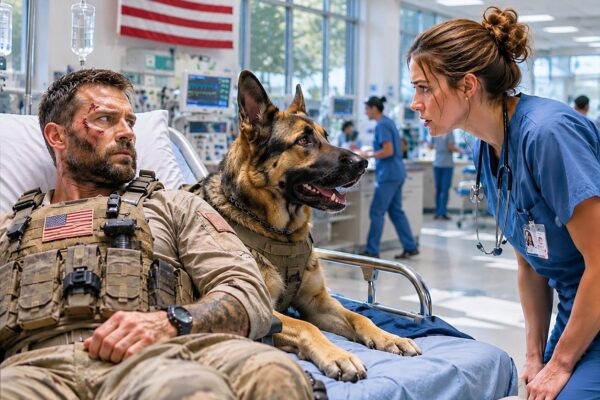
I woke up two days later.
My head was wrapped in thick surgical bandages.
My throat was dry, and my vision was blurry.
For several seconds, I couldn’t remember where I was.
Then I felt something warm against my feet.
I looked down.
Koda was curled beside the end of my hospital bed.
His enormous head rested on the blanket.
When he noticed me moving, his ears lifted.
“Hey,” I whispered.
His tail moved twice.
I started crying.
I had been told that this dog was dangerous.
I had been warned never to approach him.
Yet he had somehow become the reason I was still alive.
I reached toward him.
Koda carefully stood, navigated around the medical equipment, and rested his head against my chest.
I placed my fingers against his fur.
“Thank you.”
He closed his eyes.
For the first time since returning from Afghanistan, Koda looked completely at peace.
My recovery took several weeks.
The doctors explained that the operation had prevented a potentially catastrophic outcome.
I would need follow-up imaging, medication, and regular neurological appointments.
But I was alive.
And Koda had become an unexpected part of my recovery.
He visited under controlled supervision.
The hospital’s staff gradually became accustomed to seeing the large Belgian Malinois sitting quietly beside my bed.
A few nurses who had initially been frightened of him began bringing him treats.
Walter sometimes joked that Koda had become the most popular patient in the building.
But while I was recovering, another battle was taking place back at the rehabilitation facility.
Koda’s thirty-day trial had officially expired.
And the military had not forgotten his record.
Three injured handlers.
Multiple attacks.
Extensive rehabilitation expenses.
A classification identifying him as a dangerous, unsuitable candidate for civilian adoption.
Captain Lucas Bennett arrived at the facility with the final paperwork.
The original euthanasia authorization was still active.
His position was straightforward.
Koda had performed an extraordinary act, but one incident did not erase the danger he could pose to other people.
He was still government property.
And the military was not prepared to release an animal it considered unpredictable.
When I heard about the decision, I asked the hospital to help arrange a meeting.
Three weeks after my surgery, I returned to Pennsylvania.
My head was still wrapped beneath a light scarf.
Andrew and Walter accompanied me into the administrative office.
Captain Bennett stood behind his desk, holding a folder.
“Miss Hayes, I’m glad you’re recovering.”
“Thank you, Captain.”
“I understand you want to discuss Koda.”
“I want to adopt him.”
Bennett sighed.
“I appreciate what he did. But you need to understand that he has seriously injured trained military personnel. He cannot simply be treated like an ordinary family pet.”
“I understand.”
“Then you understand why the euthanasia decision remains under consideration.”
I looked directly at him.
“No, Captain. I understand why you’re afraid of making the wrong decision. But I also understand something about Koda that you may have overlooked.”
He folded his arms.
“Go ahead.”
“Those handlers were trying to replace Ryan.”
Bennett said nothing.
“Every time they entered his kennel wearing the same uniform, using the same commands, and approaching him the same way, he was reminded of the person he lost.”
I paused.
“Koda wasn’t looking at them and seeing new people. He was seeing Ryan die again.”
Walter lowered his eyes.
I continued.
“When I entered that yard, I wasn’t wearing a uniform. I wasn’t giving him orders. I wasn’t trying to make him into a soldier again.”
I swallowed.
“I was just a tired woman holding a broom.”
Bennett glanced toward the window.
Outside, Koda was running across the exercise yard.
Andrew had thrown him a tennis ball.
For a moment, the animal looked like an ordinary dog.
“He’s still dangerous,” Bennett said.
“Then let me give him a life where he doesn’t have to fight anymore.”
I took a breath.
“He saved my life, Captain. Your doctors couldn’t see what was happening inside my head. I didn’t know I was dying. But Koda recognized something was wrong.”
My voice trembled.
“You believe he is broken because he can’t return to his old job. I believe he deserves the chance to discover who he is without that job.”
The room fell silent.
Then Walter stood.
“Sir, I need to say something.”
Bennett turned.
“I’m the handler he injured. I know exactly how dangerous Koda can be. But I also witnessed what happened in that yard.”
Walter’s voice became rough.
“He wasn’t attacking her. He was protecting her. I’ve spent twenty years training dogs, and I’ve never seen him display that level of controlled protection since Ryan died.”
He paused.
“If we send him back to the same system that keeps reminding him of the worst day of his life, we’re not giving him a chance to recover.”
Andrew placed his rehabilitation report on the desk.
It included detailed observations of Koda’s behavior, his responses to environmental triggers, and his progress during the thirty-day program.
Bennett read the documents slowly.
Finally, he picked up his pen.
He crossed out the euthanasia authorization.
Then he wrote three words beneath it:
MEDICAL RETIREMENT APPROVED.
He looked at me.
“There’s going to be paperwork. Home inspections. Behavioral evaluations. You will need to complete specialized training before the transfer becomes permanent.”
I could barely speak.
“Does that mean he’s coming home?”
“It means he’s getting his chance.”
I covered my mouth.
Tears rolled down my cheeks.
Bringing Koda home wasn’t easy.
He still had nightmares.
Some nights, he woke suddenly, barking at shadows and pacing around the bedroom.
Sometimes a distant helicopter sent him hiding beneath the kitchen table.
I learned not to force him.
I learned to speak softly and let him decide when he was ready to approach.
And he learned something, too.
He learned that a slammed door didn’t mean an ambush was coming.
That a car engine wasn’t an approaching convoy.
That a quiet house could remain quiet.
My little farmhouse became our shared rehabilitation project.
I planted flowers along the walkway.
Koda watched from the porch.
I bought him a large orthopedic bed, although he preferred sleeping beside my bedroom door.
At night, when his dreams became frightening, I sat on the floor beside him.
“You’re home, buddy,” I whispered.
“Nobody is coming for you.”
Slowly, the trembling became less frequent.
His appetite returned.
He began playing with tennis balls again.
And something unexpected happened during my own recovery.
Koda started recognizing my warning symptoms.
If I became dizzy, he would approach and gently press his head against my leg.
If I ignored him and continued working, he would stand directly in front of me until I sat down.
My doctors warned me that recovery would take time.
Koda seemed determined to make sure I followed every instruction.
We were no longer a soldier and a working dog.
We were simply two survivors learning how to live again.
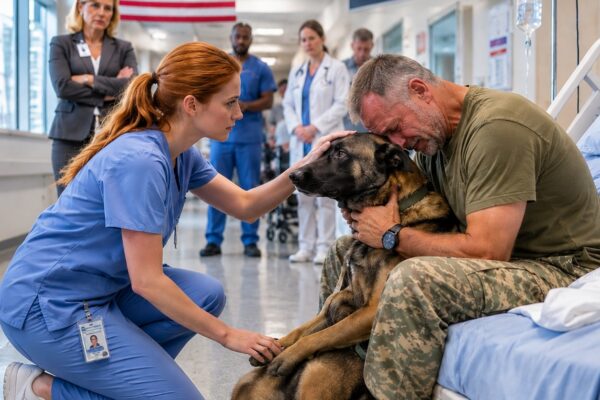
Six months later, the rehabilitation center held a small ceremony honoring retired military working dogs.
Koda attended with me.
Walter was there.
Andrew was there.
Captain Bennett even came.
Several former handlers stood in the audience.
When Koda entered the yard, some of them looked nervous.
I couldn’t blame them.
They remembered the attacks.
They remembered the dog who had once been impossible to approach.
But Koda didn’t growl.
He walked beside me, his head held high.
At the end of the ceremony, Walter approached.
He knelt slowly and extended his hand.
Koda looked at him.
For a moment, I worried.
Then the dog stepped forward and gently sniffed his fingers.
Walter’s eyes filled with tears.
“Hello again, buddy.”
Koda leaned his head against Walter’s shoulder.
The older handler began crying.
“Ryan would have loved seeing you like this.”
I looked away, wiping my eyes.
For years, Koda had been remembered for the people he injured after losing his handler.
But that day, everyone finally remembered the soldier he had been before grief took over his life.
Today, Koda is still living with me in Pennsylvania.
He has gray hairs around his muzzle now.
His old shoulder injury sometimes makes him limp when the weather turns cold.
He no longer has to wear tactical equipment or follow military commands.
His greatest responsibility is accompanying me to medical appointments and making sure I don’t forget to take my medication.
Sometimes, I catch him sleeping in the sunlight on the porch.
His paws twitch as he dreams.
I wonder whether he’s running through the mountains of Afghanistan again.
Whether he sees Ryan.
Whether, somewhere inside that complicated canine mind, he is still waiting for his handler to give him the signal that everything is safe.
When that happens, I sit beside him and gently place my hand against his back.
And eventually, he wakes.
He looks at me.
Then he rests his head in my lap.
People sometimes ask whether I’m afraid of living with a dog who once seriously injured three trained handlers.
I tell them the truth.
I respect what he is capable of.
I understand his history.
And I never forget that he needs patience, boundaries, and proper care.
But I’m not afraid of him.
Because I know something those people don’t.
The first time Koda ran toward me, everyone believed I was about to become his next victim.
But he wasn’t running toward a target.
He was running toward a person whose life was in danger.
The military had trained him to find invisible explosives buried beneath the earth.
Grief had convinced everyone that he had become nothing more than a dangerous weapon.
Yet when he saw me collapsing on that gravel path, the old soldier inside him recognized an emergency.
He didn’t need a command.
He didn’t need his handler.
He simply did what he had always done.
He protected someone who couldn’t protect herself.
And sometimes, when I look at the scar beneath his fur and remember the operation that saved my life, I think about the strange way our stories came together.
A woman nobody realized was dying.
A dog nobody believed could be saved.
Two lives that had nearly reached their final chapter.
We didn’t rescue each other in the ordinary sense.
We gave each other a reason to keep going.
And every morning, when Koda walks beside me into the sunshine, I remember the words Walter whispered at the rehabilitation center:
“The dog wasn’t broken. He had simply been waiting for someone to give him a reason to protect again.”