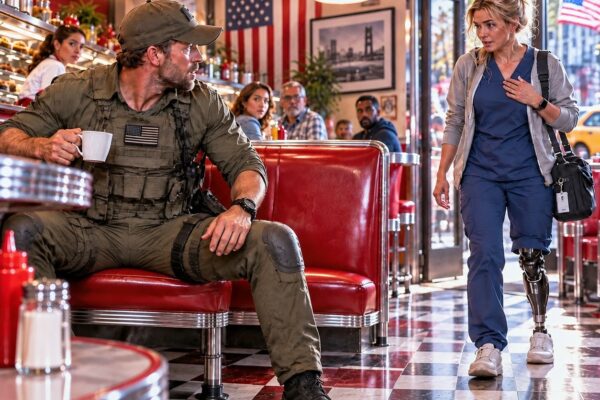
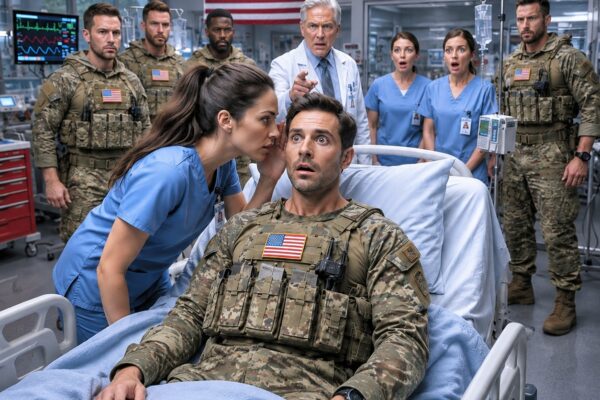
THEY LEFT THE WHEELCHAIR-BOUND NURSE BEHIND THE MEDICAL TENT, CONVINCED SHE WAS ONLY THERE TO HAND OUT WATER. THEN A FOUR-STAR ADMIRAL COLLAPSED IN FRONT OF 600 PEOPLE, HIS FOUR-YEAR-OLD SON BEGAN SCREAMING, AND EVERYONE FROZE. WHAT HAPPENED NEXT EXPOSED THE SECRET IDENTITY OF THE WOMAN THEY HAD UNDERESTIMATED FOR THREE YEARS.
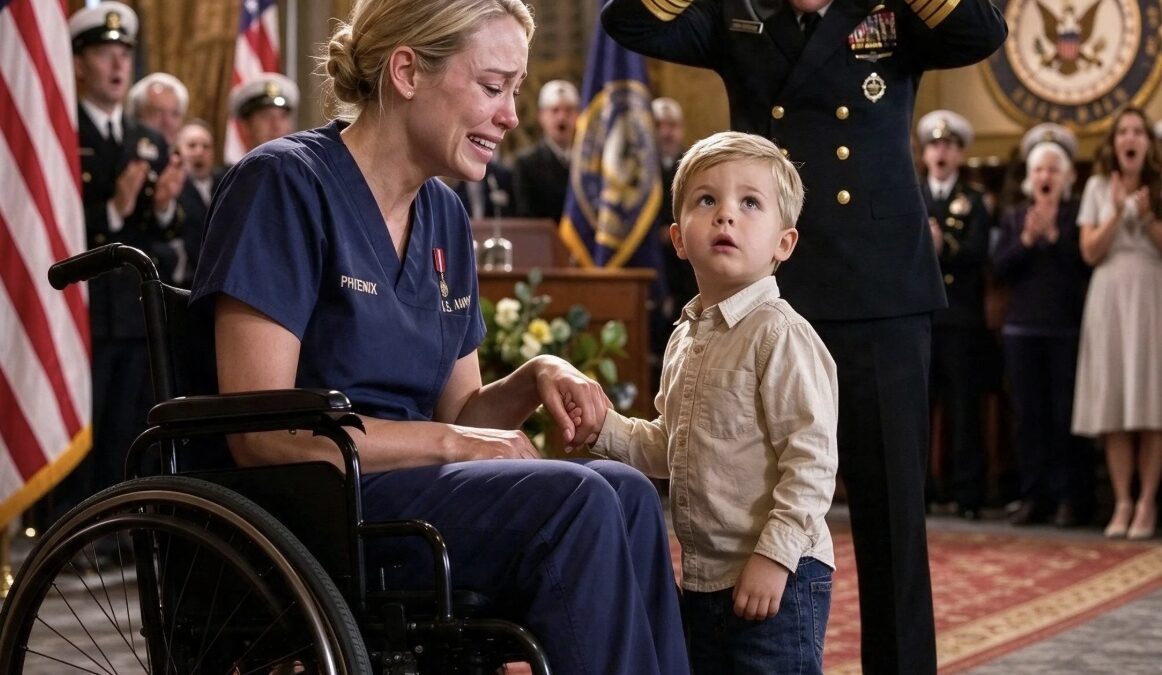
THEY LEFT THE WHEELCHAIR-BOUND NURSE BEHIND THE MEDICAL TENT, CONVINCED SHE WAS ONLY THERE TO HAND OUT WATER. THEN A FOUR-STAR ADMIRAL COLLAPSED IN FRONT OF 600 PEOPLE, HIS FOUR-YEAR-OLD SON BEGAN SCREAMING, AND EVERYONE FROZE. WHAT HAPPENED NEXT EXPOSED THE SECRET IDENTITY OF THE WOMAN THEY HAD UNDERESTIMATED FOR THREE YEARS.
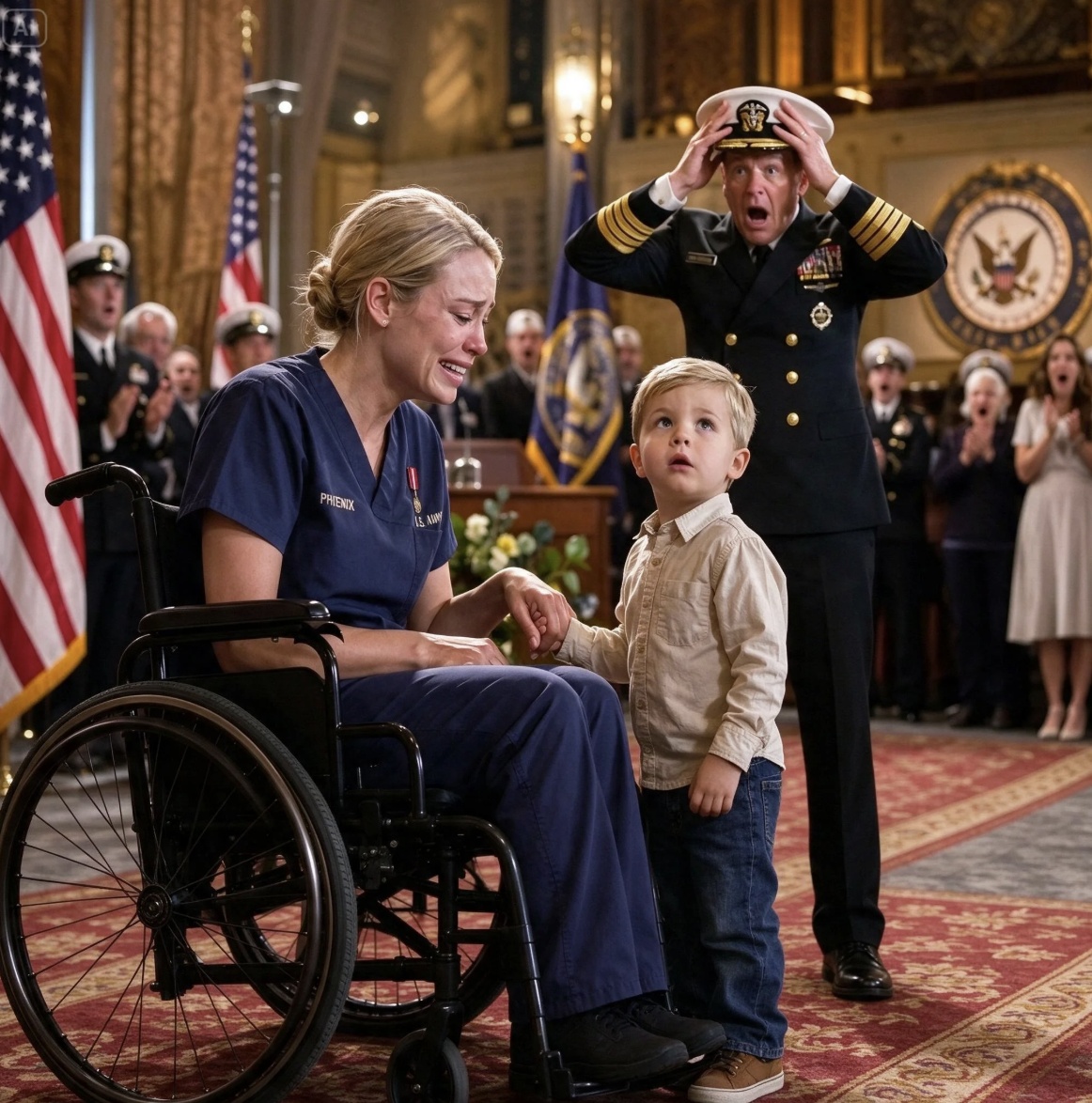
For three years, everyone at the naval medical center had treated me like a woman who would never be useful again.
They saw my wheelchair before they saw my face.
They saw my disability before they saw my nursing license.
But on the day a four-star admiral collapsed in front of 600 witnesses, they discovered that the woman they’d spent three years ignoring was the only person who could save him.
And the little boy who recognized me first would become the reason I finally stood up again.
My name is Dana Wexler. I was thirty-eight years old, a registered nurse at Naval Station Kingsley in Virginia, and I had not walked independently in three years.
Every morning, I wheeled myself into the hospital, put on my blue scrubs, and tried to convince myself that the life I had now was enough.
I wasn’t always a nurse in a wheelchair.
Before the accident, I had spent twelve years working in military intelligence, specializing in threat assessment, human intelligence, and protective operations.
I had worked alongside people whose names never appeared in public reports. I had entered dangerous rooms, recognized threats before they became emergencies, and learned to read people by the smallest movements of their hands.
Then one operation went terribly wrong.
Someone I had spent eleven months protecting died because I recognized the danger a fraction of a second too late.
The investigation cleared me of wrongdoing.
I never cleared myself.
During the operation, an explosion injured my lower spine. The doctors told me I might regain some mobility, but recovery would require years of rehabilitation.
I left military service.
I became a nurse.
And I put everything else behind me.
At least, that was what I told myself.
The hospital assigned me to routine medical support during public ceremonies. I handed out water, checked blood pressure, completed paperwork, and called for assistance when someone needed more serious attention.
Dr. Preston Voss supervised the medical team.
He was an excellent physician, but he had a terrible habit of confusing physical limitations with professional limitations.
“Remember your assignment today, Wexler,” he said as I prepared for the retirement ceremony.
“Medical support station. Water and emergency calls.”
“Exactly. Stay behind the rope. Let the physicians handle anything complicated.”
“I’m a registered nurse, Doctor.”
“And you’re working from a wheelchair. We need you in a position where you won’t get hurt.”
He walked away before I could answer.
I had learned that arguing rarely changed anyone’s opinion.
The ceremony was being held on the main parade ground. Six hundred military personnel, family members, and invited guests had gathered to honor Admiral Thomas Walsh, who was retiring after forty years of service.
His four-year-old son, Eli, was sitting with his mother near the front.
About twenty minutes before the ceremony began, Eli wandered over to my medical station.
“Are you a soldier?” he asked.
I smiled.
“Not today. Today I’m a nurse.”
He studied my wheelchair.
“Does it hurt?”
“Sometimes.”
“Then why do you smile?”
The question caught me off guard.
“Because there are still good things to smile about.”
He considered that answer seriously.
Then he looked toward the podium.
“That’s my daddy.”
I followed his finger.
“He’s going to have a very important day.”
Eli nodded.
Before his mother collected him, he looked at me again.
“You sit like my daddy.”
“How does your daddy sit?”
“Like he’s watching something bad happen.”
I stopped smiling.
Children notice things adults spend years learning to hide.
I watched him return to his mother, then turned my attention toward the crowd.
Something felt wrong.
Near the second row, a man in a charcoal suit was watching Admiral Walsh.
He wasn’t dressed like military personnel. He wore no recognizable identification, and he wasn’t speaking to anyone.
His right hand kept turning a small metallic object.
I watched him shift seats, check the northern exit, and move closer to the stage.
When a ceremony assistant approached him, he produced an identification badge.
The badge looked legitimate.
Almost.
The angle of the security barcode was wrong.
I knew because I had spent years examining credentials and identifying forged documents.
“Doctor Voss,” I called.
He glanced over.
“What?”
“Do you recognize the man near the second row?”
He barely looked.
“Probably a committee representative.”
“Something isn’t right.”
“Wexler, please. We have a retirement ceremony, not a counterterrorism operation.”
I turned back toward the crowd.
The man was now walking toward the stage carrying a small gift box.
A committee member standing nearby looked confused.
That was my first confirmation.
The man wasn’t supposed to be there.
He approached Admiral Walsh, opened the box, and presented a ceremonial pen.
The admiral smiled politely.
Then he uncapped it.
I heard a faint hiss.
His hand jerked.
The pen fell.
“Admiral!” someone shouted.
Walsh grabbed his throat and staggered backward.
His knees buckled, and his body struck the wooden platform.
For one terrible second, 600 people stood frozen.
Then the entire parade ground erupted.
Dr. Voss rushed toward the stage.
“Possible cardiac arrest! Get the AED!”
But I knew what I had seen.
The admiral’s pupils were shrinking. His muscles were twitching, and saliva was gathering around his mouth.
Those weren’t the signs of an ordinary cardiac emergency.
I recognized the pattern from a classified threat briefing years earlier.
A nerve agent.
Possibly an organophosphate compound delivered through skin contact.
“STOP!” I shouted. “He needs an antidote, not another round of compressions!”
Nobody listened.
I pushed my wheelchair toward the stage, but a security officer blocked my path.
“Ma’am, stay behind the line.”
“I’m a nurse. Let me through!”
“The medical team has it handled.”
It didn’t.
Voss was already beginning chest compressions while the admiral struggled to breathe.
I knew we were losing precious seconds.
Then I heard a child scream.
“DADDY!”
Eli was standing beside his mother, trying to reach the stage.
His little face was twisted with fear.
I looked at him.
Then at the admiral.
Then down at my legs.
For three years, I had accepted that my body might never work the way it once had.
For three years, I had allowed the wheelchair to become the boundary of my life.
But I couldn’t watch another person die while I sat helplessly behind a rope.
I gripped both armrests.
“Move,” I whispered to my legs.
Nothing happened.
I tried again, forcing my weight forward.
My knees struck the grass.
Pain shot through my body.
The security officer reached for me.
“Ma’am, don’t!”
“Then catch me.”
I grabbed his forearm, pulled myself upright, and somehow found my balance.
For the first time in three years, I was standing.
The crowd barely noticed.
Everyone was watching the dying admiral.
I took one unsteady step, then another, and crossed the rope line.
“GET OFF HIM!” I shouted at Dr. Voss.
He turned furiously.
“Wexler, what do you think you’re doing?”
I looked directly into his eyes.
“Saving his life. And if you don’t listen to me, you’re going to kill him.”
Then I gave him the diagnosis that changed everything.
“This isn’t a heart attack. Someone just tried to assassinate Admiral Walsh with a nerve agent.”
But as I dropped beside the admiral, I noticed something even more terrifying.
The man with the gift box was already disappearing toward the northern gate.
And he wasn’t the only person watching the admiral’s four-year-old son.
PART 2 — THE SECRET SHE HAD BURIED
“Get me the emergency antidote kit!” I ordered.
Dr. Voss stared at me as though he couldn’t decide whether to argue or obey.
“You’re making a serious accusation.”
“Then make it after he’s breathing.”
I turned toward the corpsman beside me.
“Check his airway. Get suction. I need atropine and pralidoxime from the emergency medical supply.”
The corpsman looked at Voss.
“Doctor?”
Voss hesitated.
That hesitation nearly cost us everything.
“Do it!” I shouted.
He finally nodded.
I positioned the admiral’s head to help protect his airway while the medical team prepared the appropriate treatment under emergency protocols.
His breathing was becoming dangerously compromised.
The antidotes arrived.
I checked the medication, confirmed the doses with the physician, and directed their administration according to the suspected exposure and the emergency protocol.
“Monitor his heart rate. Watch his breathing. Prepare for airway support.”
The team moved.
Within minutes, the admiral’s violent muscle spasms began to lessen.
His breathing remained difficult, but he was responding.
I exhaled.
We had bought him time.
Then I looked toward the northern gate.
The suspect had disappeared.
“Security!” I called. “Find the man in the charcoal suit. He’s not your only concern.”
A young officer hurried toward me.
“What do you mean?”
“The admiral’s collapse was designed to draw everyone’s attention toward the stage.”
I pointed toward the family seating.
“His son is the secondary target.”
The officer’s face changed.
He immediately called for additional security.
I pushed myself away from the admiral and began walking toward the family section.
My legs were trembling so badly that every step felt like walking on unfamiliar ground.
But I kept moving.
Eli’s mother, Sarah, was holding him near the edge of the seating area.
A man in a navy polo shirt was approaching them.
He wore a staff identification badge.
His smile was warm.
His movements were not.
I noticed that he wasn’t looking at Sarah.
He was watching Eli.
His right hand remained hidden beside his hip.
“Ma’am!” I shouted. “Move away from him!”
Sarah turned.
The man reached toward the boy.
I moved faster.
“Don’t touch that child!”
He looked at me with a flash of irritation.
For a fraction of a second, I saw him assess my wheelchair, my blue scrubs, and my unsteady legs.
He dismissed me.
That was his mistake.
I caught his wrist before he could reach Eli.
A small electronic device slipped from his hand and landed in the grass.
He twisted toward me.
The impact sent pain through my shoulder, but my training returned almost instinctively.
I redirected his weight, locked his arm, and drove him onto the ground.
He struggled.
I held on.
“SECURITY! NOW!”
Three officers arrived and secured his arms.
One immediately moved the device away from the crowd while calling the bomb squad.
Sarah pulled Eli against her chest.
The little boy was crying.
I knelt beside him.
“You’re safe now.”
He looked at my face.
Then at my legs.
“You stood up.”
I swallowed.
“Yes, sweetheart. I did.”
“Are you going to sit down again?”
I smiled through the pain.
“Probably. My legs aren’t very happy with me.”
He wrapped his small arms around my neck.
And something inside me finally broke.
Not from fear.
From relief.
For three years, I had believed that the worst thing that happened during that operation overseas was the loss of my mobility.
But it wasn’t.
The worst thing was what I had decided about myself afterward.
I had convinced myself that because I failed once, I no longer deserved to trust my instincts.
I had mistaken guilt for responsibility.
And I had allowed that guilt to become a prison.
A few minutes later, the security team confirmed that both suspects were in custody.
The first man had attempted to escape through the northern gate.
The second had been carrying a device designed to create a secondary emergency near the family section.
Investigators later determined that the attack had been planned to eliminate Admiral Walsh and his son.
The admiral’s retirement ceremony had provided the perfect opportunity.
The first attack was meant to create panic.
The second was supposed to happen while security personnel rushed toward the stage.
But the plan had failed.
Because one nurse had noticed the details everyone else ignored.
And because a four-year-old boy had noticed her before anyone else did.
Admiral Walsh survived.
He was transferred to the military medical center for continued treatment and recovered over the following weeks.
The first person he asked to see after regaining consciousness was his son.
The second was me.
When I entered his hospital room, he was sitting upright with an IV in his arm.
Sarah stood beside him.
Eli was playing with a small toy ship on the windowsill.
The admiral extended his hand.
“Miss Wexler.”
“Sir.”
“I hear I owe you my life.”
“You owe your medical team a thank-you. They did excellent work.”
He smiled faintly.
“That’s not what my security chief told me.”
I looked down.
He studied my face.
“Why didn’t you tell anyone who you were?”
I was silent.
“Your background was reviewed after the incident. Twelve years in military intelligence. Advanced threat assessment. Protective operations. Specialized training.”
He paused.
“Then three years in a wheelchair, working at a medical station where nobody thought to ask what you could actually do.”
I looked toward the window.
“After my last operation, I didn’t want to be that person anymore.”
“Why?”
“Because someone died while I was responsible for protecting him.”
The admiral’s expression softened.
“Someone died while I was responsible for protecting thousands of people over forty years. Some of those losses still keep me awake.”
I looked at him.
He continued.
“Leadership doesn’t mean you prevent every tragedy. It means you accept responsibility without allowing one failure to destroy everything you still have to give.”
His words stayed with me.
Then he asked the question I had avoided for three years.
“Do you believe you’re ready to walk again?”
I glanced down at my legs.
“I don’t know.”
“Then don’t make that decision today.”
He nodded toward Eli.
“Just keep showing up.”
The investigation revealed an even darker story.
The first attacker had been working with a private security contractor who had previously supplied personnel to several military facilities.
The false credentials had been created using legitimate access information stolen months earlier.
The device presented to Admiral Walsh had been specially modified to expose him to a toxic substance when he handled the pen.
The second attacker had been assigned to target Eli during the confusion.
Their motive was connected to an intelligence investigation the admiral had overseen before retirement.
He had been preparing to testify about a network that had secretly sold restricted military information.
His son had become leverage.
The authorities never released every detail, but they confirmed that the attack had been planned for months.
And my observations had helped investigators understand how the operation unfolded.
Two weeks later, I received a visit from Colonel Richard Ashby.
He had been my former commanding officer and one of the few people who had never stopped believing in me.
He entered my hospital office carrying a folder.
“I heard you made quite an entrance at the retirement ceremony.”
I smiled.
“Word travels fast.”
“Apparently, you stood up.”
“With considerable assistance.”
He pulled a chair closer.
“Why didn’t you call me after you left?”
I looked away.
“Because I didn’t want you to see what had happened to me.”
He shook his head.
“Dana, I trained you for twelve years. I watched you walk into rooms where people twice your age were afraid to enter. Do you honestly think a wheelchair changes what I remember?”
I couldn’t answer.
He placed the folder on my desk.
“I have a proposal.”
Inside were documents for a new military medical security training initiative.
They wanted someone with intelligence experience and medical qualifications to teach hospital personnel how to recognize suspicious behavior, identify potential threats, and coordinate emergency responses.
He wanted me to lead it.
“Why me?”
“Because you understand something most people don’t.”
“What?”
“An emergency rarely begins when someone screams. It begins much earlier, when somebody notices something that doesn’t belong.”
I looked at the papers.
“I can’t return to field operations.”
“I’m not asking you to.”
He smiled.
“I’m asking you to teach the next generation how to recognize danger before it reaches the people they’re supposed to protect.”
For the first time in three years, the future didn’t feel like something I had lost.
It felt like something I might still build.
Dr. Voss visited me the following afternoon.
He stood in the doorway for several seconds before speaking.
“Dana, may I come in?”
“Of course.”
He looked uncomfortable.
“I owe you an apology.”
I waited.
“I treated your wheelchair as if it defined your abilities. I questioned your judgment without understanding your experience. And when you tried to warn us, I dismissed you.”
He took a breath.
“I was wrong.”
I looked at him.
“Yes, you were.”
He nodded.
“I know.”
“I don’t need you to feel guilty, Doctor. I need you to remember this the next time someone looks different from what you expect a capable professional to look like.”
He lowered his eyes.
“I will.”
Then he added something I hadn’t expected.
“I’d like you to help us revise our emergency response training. If you’re willing.”
I smiled.
“That sounds like a much better use of my time than handing out water.”
He laughed.
For the first time, we understood each other.
Six weeks later, Naval Station Kingsley launched its new protective medical response program.
I taught the first class standing beside a presentation screen.
My legs were still weak.
I used a cane, and on difficult days, I still needed my wheelchair.
But I no longer apologized for either.
The program trained medical staff and security personnel to recognize behavioral warning signs, coordinate emergency responses, and protect vulnerable people during public events.
Admiral Walsh attended the opening ceremony with Sarah and Eli.
He had recovered enough to walk without assistance.
When he introduced me, the room stood.
I didn’t know what to do with the applause.
For three years, I had become accustomed to people looking past me.
Now they were looking directly at me.
After the ceremony, Eli ran toward me.
“Miss Dana!”
I knelt carefully.
“Hello, young man.”
He looked at my cane.
“Do you still need that?”
“Sometimes.”
“Does it make you a soldier again?”
I laughed.
“No. It just helps me walk.”
He thought about that.
Then he said something I would remember for the rest of my life.
“My daddy says you’re brave because you stood up when everybody else was scared.”
I looked toward Admiral Walsh.
He was watching us with a quiet smile.
I turned back to Eli.
“Your daddy is very kind.”
“No,” Eli said. “I’m right.”
Children have a way of making complicated things very simple.
That evening, after everyone had left, I returned to the parade ground.
The folding chairs were gone.
The stage had been dismantled.
The grass was empty except for a few footprints.
I stopped near the spot where my wheelchair had been parked that morning.
I remembered the moment I had gripped the armrests.
I remembered the pain.
I remembered how frightened I had been.
And I remembered the little boy screaming for his father.
For three years, I had believed my greatest failure was that I hadn’t saved someone.
But that day, I had saved a father for his son.
And perhaps, in doing so, I had finally saved a part of myself.
I still have my wheelchair.
I still have difficult mornings.
Some days my legs cooperate. Some days they don’t.
But I no longer measure my worth by how far I can walk.
I measure it by what I can still give.
The people at Naval Station Kingsley once saw a disabled nurse who belonged behind a rope line.
They never bothered to ask who she had been.
Now, whenever I train new medical personnel, I tell them one thing before we begin:
“Never mistake the way someone moves for the limits of what they can do. And never assume the quietest person in the room has the least experience.”
Because the woman in the wheelchair wasn’t waiting for someone to rescue her.
She was waiting for a reason to believe she still had a future.
And sometimes, all it takes to change someone’s life is one frightened little boy looking at them and seeing what everyone else has forgotten.
I didn’t stand up that day because my legs suddenly became strong. I stood up because, for the first time in three years, I finally remembered that I still had a reason to stand.