My Father Brought Home the Prophet Who Had Defied Our King and Set Bread Before Him. By Sunset, I Was Helping Carry That Stranger to Our Family Tomb—and My Father Was Asking to Be Buried Beside Him.
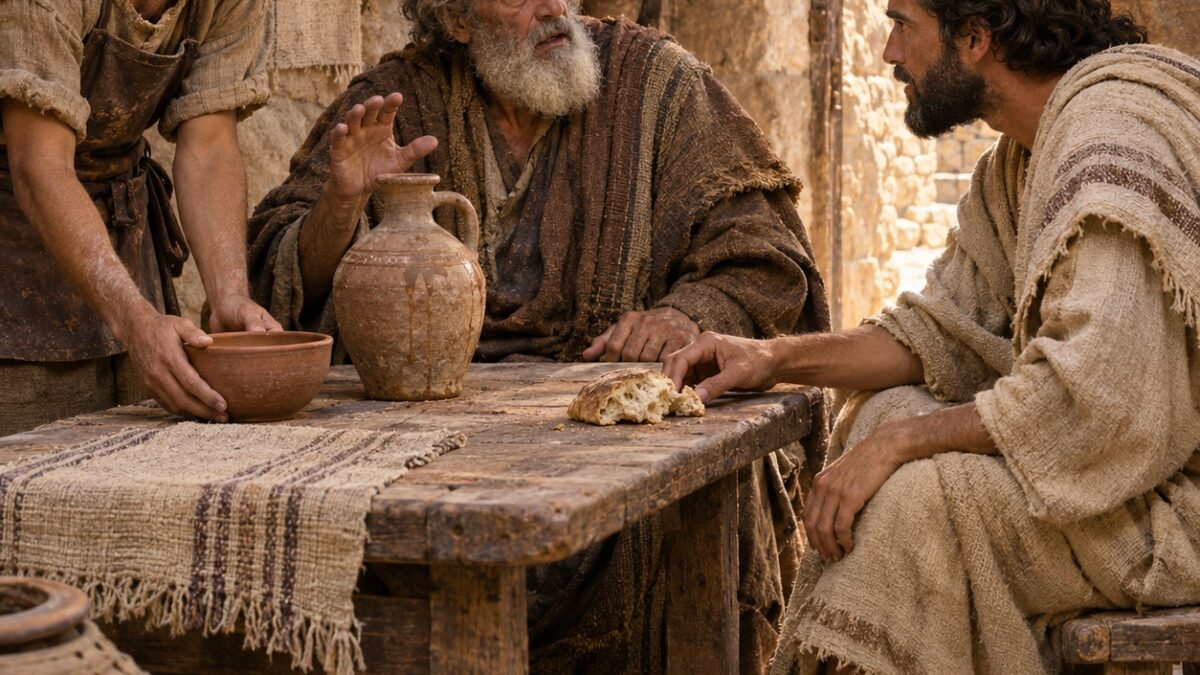
The stranger had already broken the bread when my father stopped speaking.
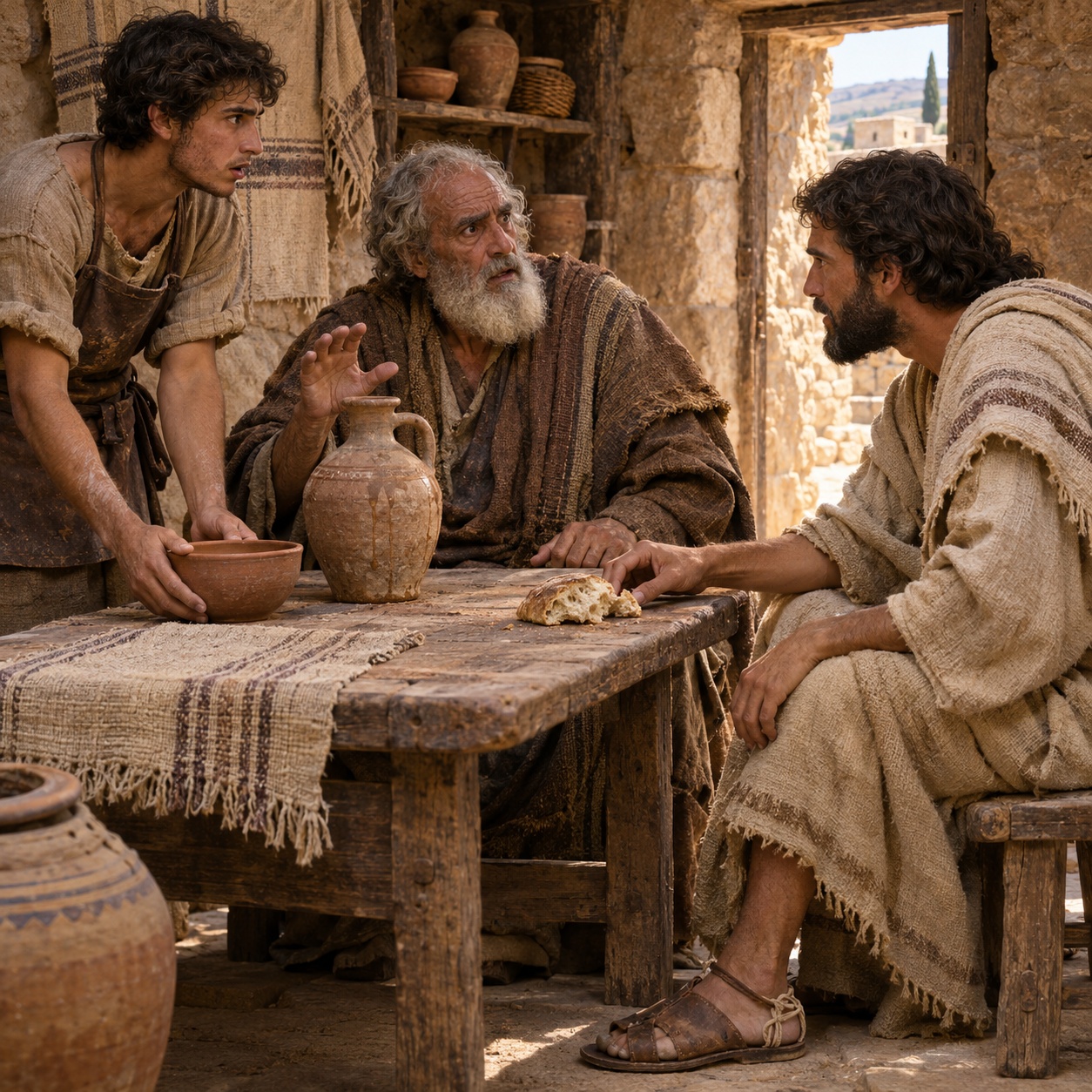
His hand remained above the water jar. A drop ran down his wrist and fell onto the table.
Then he looked at our guest and spoke in a voice that made me set down the bowl I was carrying.
“You will never reach your father’s tomb.”
The stranger lowered the bread.
I looked from one man to the other, waiting for my father to explain what he meant. Only an hour earlier, he had insisted this same man come home with us. He had called him a brother. He had promised that the command keeping him away from our table had been changed.
Now our guest was staring at the water he had just drunk.
I had spent my whole life listening to my father speak for God.
That afternoon was the first time I wished I had stopped someone from believing him.
I was a potter’s apprentice then, old enough to earn my place at the kiln and still living beneath my father’s roof in Bethel. My brothers and I knew which visitors required clean cups and which could drink from whatever stood nearest the door.
Our father had once drawn crowds.
In those days, people still greeted him as a prophet, but fewer came seeking his counsel. He spent long afternoons at the doorway, watching people pass toward the king’s sanctuary.
That morning, my younger brother and I had gone there ourselves.
King Jeroboam stood beside the altar. Smoke drifted over the crowd, and attendants kept pushing us back whenever we leaned forward to see.
Then a traveler stepped between them.
His clothes were dusty. One sandal had been repaired with pale cord. He carried no offering.
He spoke to the altar.
I remember that most clearly. The king was close enough to hear him breathe, yet the stranger addressed the stone.
He named a future ruler from David’s house. Josiah.
He said that ruler would bring judgment upon that very place.
A man beside me muttered that the traveler had come to die.
The stranger announced a sign.
The altar would split, and its ashes would spill onto the ground.
Jeroboam thrust out his arm.
“Take him.”
The guards moved.
Then the king made a sound I had never heard from anyone wearing fine clothes.
His arm had stiffened where he held it. His fingers would not close. He tried to draw the hand toward his chest and couldn’t.
Before anyone reached the stranger, the altar cracked.
Ash slid through the opening and spread across the paving stones.
I grabbed my brother’s sleeve.
The crowd pressed backward. Someone stepped on my foot, but I scarcely felt it.
The king asked the traveler to pray.
The same voice that had ordered his arrest now begged him for help.
The stranger prayed, and Jeroboam bent his elbow.
He opened and closed his hand, staring at it.
Then he offered the man food, rest, and a gift.
The traveler refused.
He said he had been commanded to eat no bread and drink no water there, and to return by a different road.
He spoke plainly enough that even those of us near the back understood.
My brother and I ran home.
Father listened without interrupting. When I described the broken altar, he leaned forward. When I repeated the name Josiah, he asked me to say it again.
Then he asked which road the man had taken.
I pointed toward the southern hills.
“Saddle the donkey.”
I thought he wanted to hear the prophecy for himself.
We found the traveler beneath an oak beyond the last houses. His head rested against the trunk, and one hand lay open on his knee.
Father dismounted.
“Are you the man who came from Judah?”
The traveler lifted his head.
Father invited him home.
The man refused, repeating the same command he had given the king.
I had brought a waterskin. I shifted it against my hip, wondering whether I should offer it, then remembered what he’d said.
Father stepped closer.
“I serve as a prophet, too,” he told him. “A messenger of the Lord came to me. I was told to bring you back and feed you.”
The traveler looked at me.
I glanced toward my father.
All my life, that had been enough.
At last the man rose.
Back home, I washed his feet while my brother set out bread. Father brought water himself.
Our guest thanked us. He took a small drink, closed his eyes, and swallowed.
Then came my father’s silence.
The drop from his wrist.
The words about the tomb.
The traveler laid the bread on the table and asked, “Did the messenger ever come to you?”
My father put down the jar.
He looked at the stranger’s plate.
“Did he?” the man asked again.
“No.”
I felt the bowl slipping and lowered it onto the floor.
The traveler sat without moving. There was dust in the fold of his sleeve, and a small damp mark on his beard where the water had touched it.
I remember those things because I couldn’t bear to look at his face.
Father drew a breath.
“The word given to me now was true.”
Our guest looked up.
“You told me the first one was true.”
My younger brother stood near the doorway. He was holding the cloth we had used to dry the traveler’s feet.
He twisted it until water fell between his fingers.
Father began repeating the message that had come over him at the table. The stranger had returned. He had eaten and drunk where he had been forbidden. He would die away from the burial place of his fathers.
Nobody disputed what the man had done.
The plate and cup sat between them.
“But he came because of you,” I said.
Father shut his eyes.
The traveler turned toward me.
“What is your name?”
I told him.
He repeated it softly, making sure he had heard.
Then he asked whether I would bring his sandal from beside the door.
It was such an ordinary request that for a moment I thought the meal might continue. He would put on his sandal, my father would say something that made sense, and we would all find our way out of what had happened.
I knelt beside him.
The repaired strap had rubbed a raw place above his heel. I loosened the cord, then tightened it where it would hold without pressing the sore skin.
“Too much?”
He shook his head.
I could feel him watching my hands.
“You heard what I said at the sanctuary?”
“Yes.”
“And under the oak?”
“Yes.”
I finished the knot.
“I should have spoken.”
He rested his hand briefly on my shoulder.
Then he stood.
Father offered to let him remain until the heat passed.
The stranger looked at him for a long moment.
“I need to leave.”
My father went outside to saddle the donkey.
I followed our guest into the courtyard. He stood in the shade while my brother brought his staff.
Beyond the wall, Bethel sounded much as it always did. A woman called for a child. Wheels rattled past. Somewhere, someone was arguing over the price of grain.
I wanted the whole town to fall quiet.
Father led the animal forward.
The stranger accepted the reins but made no move to mount.
“Why?” he asked.
Father rubbed the leather between his fingers.
“I wanted you here.”
“You could have asked me again.”
“You had already refused.”
The man nodded once, slowly.
My father’s mouth opened, then closed.
I knew that movement. He made it when searching for the beginning of a proclamation, when everyone waited and he wanted the first words to carry weight.
This time, the stranger didn’t wait.
He mounted and adjusted the hem of his garment over the donkey’s back.
I reached for a small bundle of bread by the door.
Then I stopped with my hand above it.
He saw.
“Leave it.”
I did.
We watched him take the road beyond the houses.
Father remained at the gate until the donkey disappeared around the bend.
Then he went inside.
The cups were still on the table.
My brother began gathering them, but I took the jar from him and told him to go outside.
Father sat in the traveler’s place.
“Did you think he would obey you?” I asked.
He looked at the bread.
“I thought he would come.”
“That’s what I asked.”
His eyes rose to mine.
There was anger in them for a moment. I had answered him too sharply. On another day, I would have lowered my head.
I stayed standing.
At last he said, “You came home speaking of him as though no one had ever heard God before.”
I remembered how quickly we had talked, each of us interrupting the other. I had described the king’s hand twice. My brother had spread flour across the table to show how the ashes fell.
We had made our father listen to every detail.
“You could have gone to hear him,” I said.
“I did.”
“And then?”
His fingers closed around the edge of the table.
“I wanted him to sit here. I wanted people to know he had come to my house.”
There it was.
No heavenly messenger.
No change in the command.
A chair at our table that my father wanted filled.
I went outside and sat beside my brother.
He asked whether the traveler would get home.
I watched the road.
“I don’t know.”
The first men who brought word came while the light was beginning to soften.
They were travelers carrying bundles on a pack animal. One stopped at the well and asked whether anyone knew the man who had left town on a donkey.
I stood before he finished.
Father came out behind me.
The man described a body beside the road.
A lion stood nearby.
The donkey was still there, too.
The traveler kept repeating that last part. The donkey had stayed. The lion had left it alone.
My brother gripped my wrist.
Father said the man from Judah had been overtaken by the judgment announced at our table.
The traveler looked at him.
“You knew him?”
Father nodded.
I waited for him to say the rest.
He asked us to saddle another donkey.
We took a blanket and a length of rope. My brother wanted to come, but I told him to stay at the house.
He followed us as far as the well.
On the road, Father rode ahead. His back swayed with the animal’s steps, and I walked close enough to catch him if he lost his balance.
Neither of us spoke.
At the bend, I saw the donkey first.
It stood with its reins hanging loose. Flies moved around its face, and it flicked one ear.
Then I saw the lion.
I caught my father’s sleeve before he could step forward.
The animal turned its head toward us.
I had never been so near one. Its chest moved slowly. Dust clung to the fur along its legs.
The stranger lay a short distance away, partly hidden by the rise of the road.
One heel showed beneath his garment.
I knew the knot I had tied.
Father said something under his breath.
I tightened my grip on his sleeve.
We stood there until my legs began to ache.
The lion neither approached nor fled. The donkey shifted its weight and lowered its head.
Finally Father stepped away from me.
I wanted to call him back, but the sound wouldn’t come.
He went to the body.
The lion watched.
When Father knelt, I forced myself to follow.
I laid the blanket down. We worked slowly, lifting the stranger with the care we should have given him while he was alive.
His staff lay near his hand.
I picked it up and brushed the dirt from it.
Father wept as we secured the body across the donkey.
He called the man his brother.
I had heard him use that word beneath the oak.
I kept my eyes on the rope.
We brought him back through Bethel before dark.
People came from doorways.
Some had seen the altar break. Others had heard about the king’s hand. They recognized the garment, the staff, the repaired sandal.
One woman asked whether this was the man who had refused the king’s meal.
“Yes,” I said.
Father was crying too hard to answer.
We took the stranger to our family tomb.
It had been cut into a low slope outside town. I had played near it as a child, running my fingers along the tool marks in the stone.
That evening I fetched water to clean a man whose name I still didn’t know.
I straightened his garment.
Father laid his staff beside him.
For a while, we stood shoulder to shoulder in the cooling chamber.
Then Father said, “When my time comes, put me here.”
I thought he meant the tomb.
He touched the stone beside the stranger.
“Close to him.”
I turned.
“Why?”
“What he spoke against the altar will happen.”
“Then tell the people what you did.”
He looked toward the entrance.
“His words will reach beyond Bethel,” he said. “The shrines in the northern towns will fall. The graves around them will be opened.”
I watched his hand remain on the stone.
“You want him beside you when that happens.”
Father didn’t answer.
Outside, a bird scratched in the brush.
I waited for him to say he wanted to remain near the man because he loved him. Or because he hoped, somehow, to ask forgiveness.
He said, “Remember where I have asked you to put me.”
I stepped out of the chamber.
The air felt cold against my wet hands.
For days afterward, people came to our house.
They wanted the story of the meal, the warning, and the road.
Father told them about the lion standing beside the donkey. He described the body left untouched. He repeated the stranger’s prophecy.
When they asked how the man had come to eat with us, he said he had invited him.
The first time, I said nothing.
The second time, I was outside drawing water.
The third time, I stood in the doorway with a cup in my hand and heard Father say the traveler had returned willingly.
I set the cup down.
“He returned because my father told him a messenger had changed his command.”
The visitors looked at me.
Father lowered his head.
“Was there a messenger?” one man asked.
“No,” I said.
I waited.
At last Father said, “There was none.”
Nobody spoke for a while.
One of the visitors rose and left. Another remained seated, rubbing his thumb over the rim of his cup.
Father never thanked me for speaking.
He didn’t forbid it, either.
After that, whenever someone asked me about the traveler, I began at the sanctuary and told what I had heard. I repeated the refusal given to the king. I told them what happened under the oak.
I stopped where my own knowledge stopped.
I couldn’t explain why the sentence had come through my father’s mouth. I couldn’t make the stranger’s choice smaller, or make my father’s lie carry less weight.
I could tell them who had said what.
Years later, when Father died, my brother and I carried him to the place he had chosen.
By then, the pale cord on the stranger’s sandal had darkened with age.
I placed Father beside him.
My brother stood at the entrance holding the lamp.
“Will you mark it?” he asked.
I had brought a small clay tablet, hardened in the kiln where I now worked for myself.
On it, I had recorded that the man from Judah had spoken against the altar in Bethel. I had included the name he announced.
Josiah.
Beneath that, I had recorded that he returned to eat after a prophet of Bethel falsely claimed to bring a command from God.
I set the tablet where visitors would see it before entering.
My brother lifted the lamp so I could straighten it.
Then we closed the tomb.