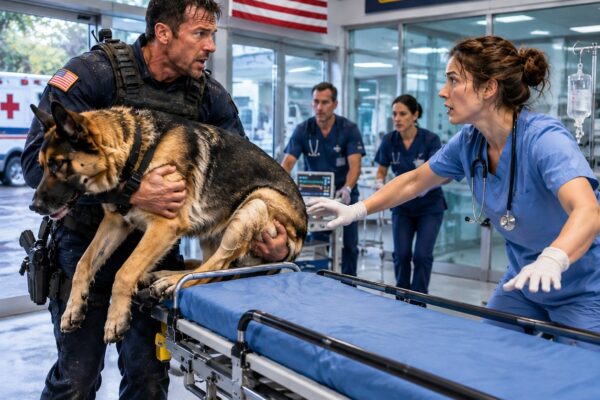
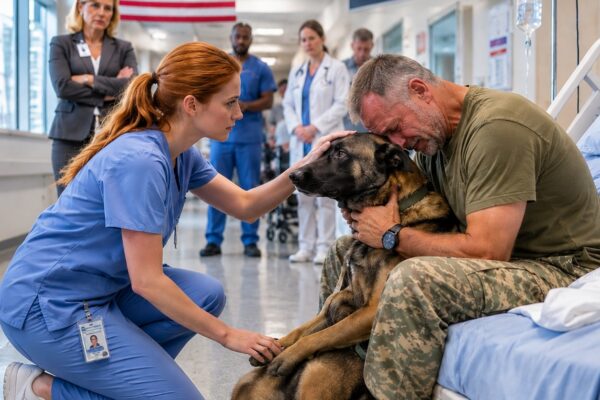
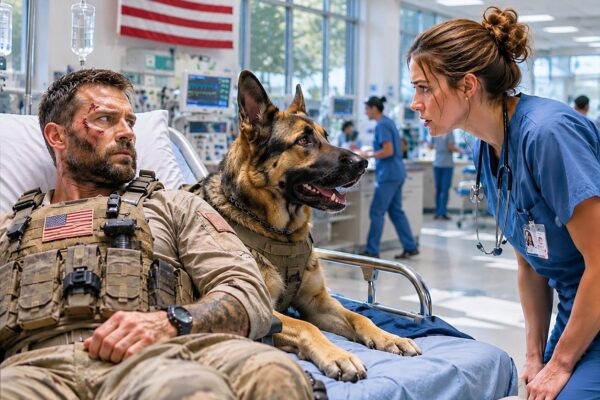
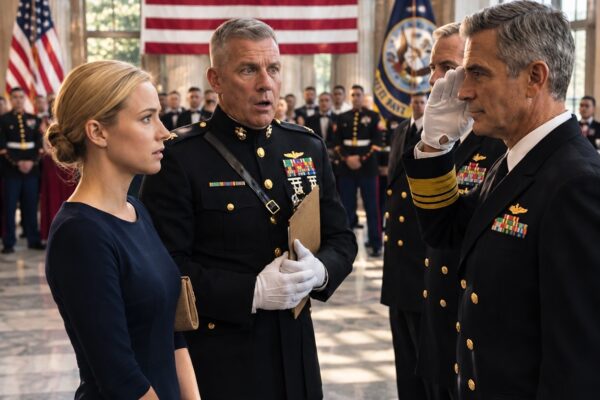
SEVEN MILITARY K9 DOGS SUDDENLY ABANDONED THEIR FORMATION AND RAN TOWARD A WOMAN IN A WORN-OUT JACKET—THE SAME WOMAN A VOLUNTEER HAD JUST ORDERED TO LEAVE THE MILITARY FAMILY SECTION. WHEN THE COMMANDING COLONEL DISCOVERED WHY THE DOGS REFUSED TO LEAVE HER SIDE, HE ORDERED AN EMERGENCY SEARCH OF A CLASSIFIED FILE THAT THE ARMY HAD KEPT BURIED FOR FIVE YEARS. WHAT THEY FOUND WOULD CHANGE EVERYTHING.
SEVEN MILITARY K9 DOGS SUDDENLY ABANDONED THEIR FORMATION AND RAN TOWARD A WOMAN IN A WORN-OUT JACKET—THE SAME WOMAN A VOLUNTEER HAD JUST ORDERED TO LEAVE THE MILITARY FAMILY SECTION. WHEN THE COMMANDING COLONEL DISCOVERED WHY THE DOGS REFUSED TO LEAVE HER SIDE, HE ORDERED AN EMERGENCY SEARCH OF A CLASSIFIED FILE THAT THE ARMY HAD KEPT BURIED FOR FIVE YEARS. WHAT THEY FOUND WOULD CHANGE EVERYTHING.
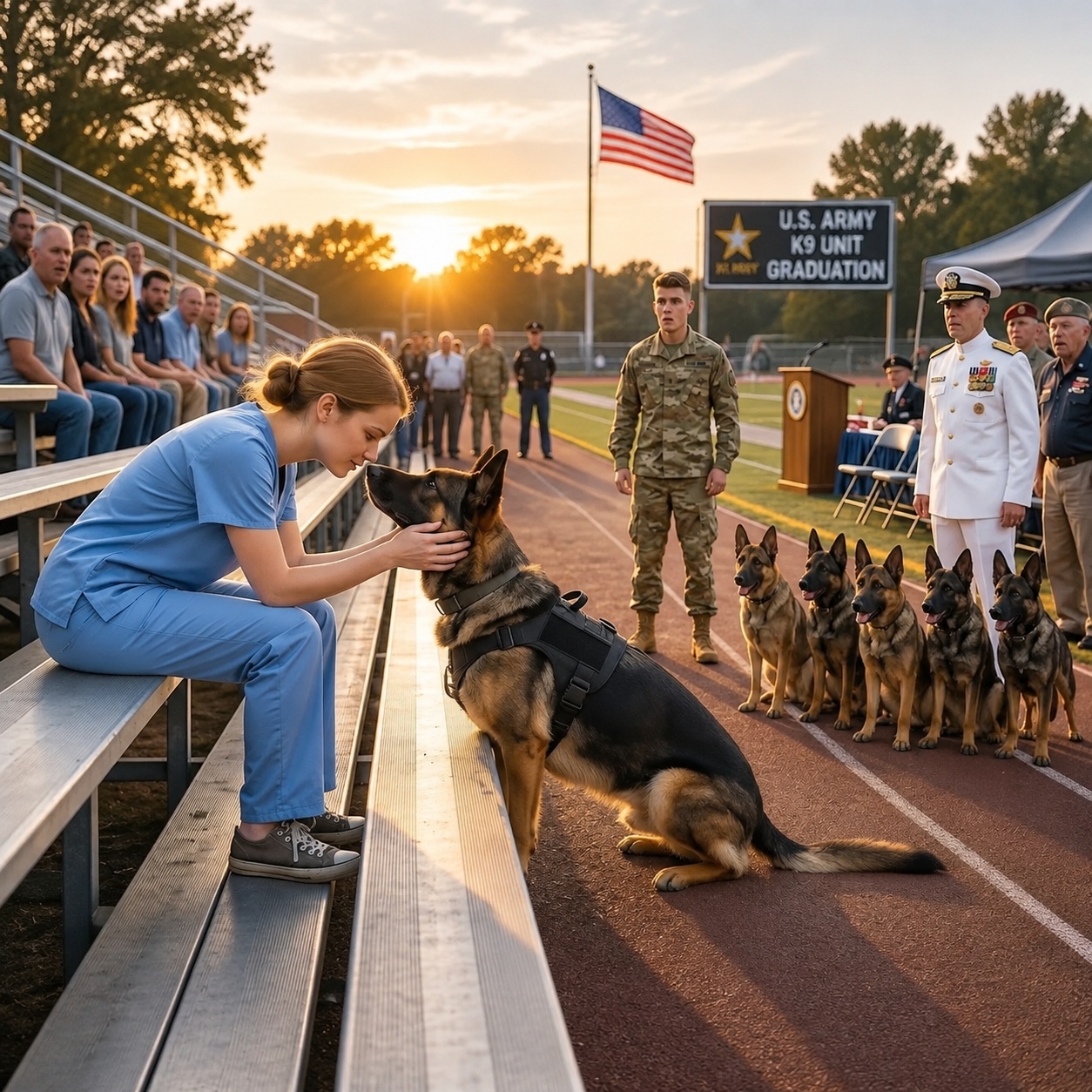
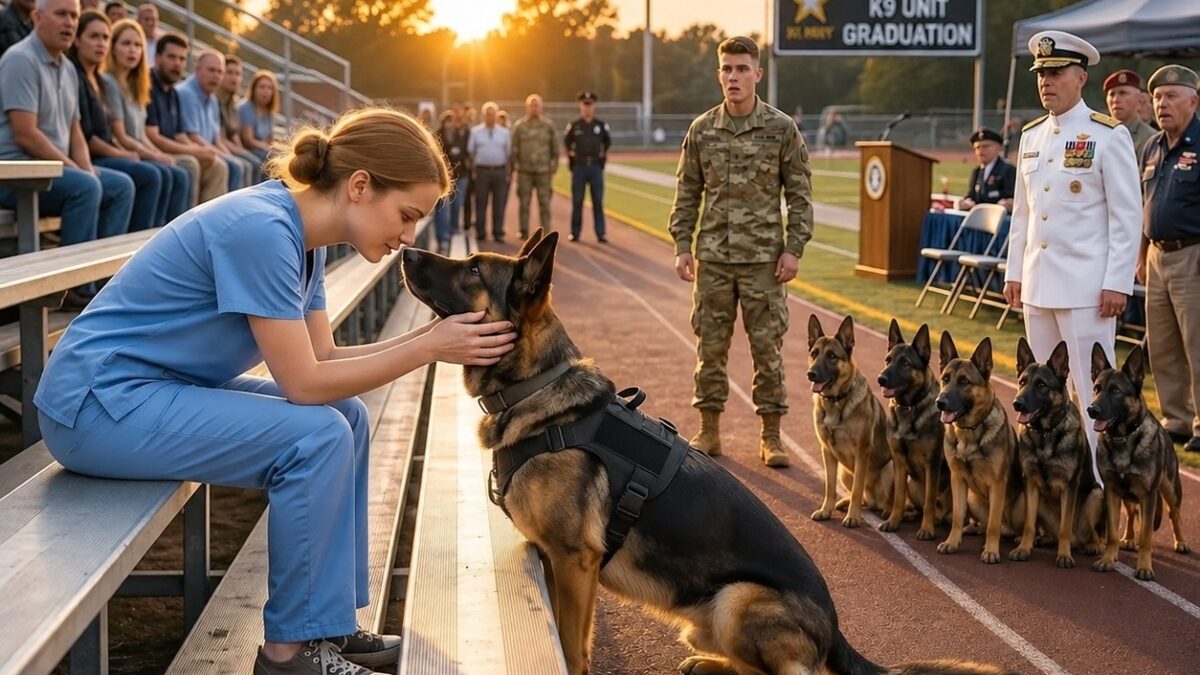
The woman in the faded gray jacket was being pushed out of the military family section when seven highly trained military dogs suddenly broke formation.
Three hundred soldiers watched as the animals raced across the parade ground.
Their handlers shouted commands.
None of the dogs listened.
They surrounded the woman, pressed against her legs, and began whining as if they had finally found someone they had been searching for years.
And when she whispered four words to the oldest dog, even the commanding colonel stopped breathing.
My name is Rachel Bennett. I was thirty-one years old, a civilian nurse, and someone who had spent five years trying to forget the most painful chapter of her life.
I lived alone in a small apartment in Cedar Falls, Montana, six blocks from Iron Ridge Veterans Medical Center, where I worked twelve-hour shifts.
I didn’t wear military clothing. I didn’t display medals. I rarely discussed my past.
Most of my coworkers didn’t even know I had served.
The gray jacket I wore that morning had a broken zipper and sleeves that were slightly too long. It was the same jacket I’d worn to nearly every military remembrance ceremony since moving to Montana.
I wasn’t there to attract attention.
I simply wanted to attend the retirement ceremony of Colonel Michael Hargrove, a thirty-year Army veteran who was ending his assignment as commander of Fort Calder.
I arrived early and sat near the front.
The autumn wind moved across the American flags while families filled the bleachers. Soldiers stood in perfect formation, their uniforms immaculate.
I watched quietly, holding a paper cup of coffee.
For a few minutes, I almost felt like I belonged to that world again.
Then a volunteer approached.
Her name was Denise Cardy. She was in her fifties, carried a clipboard, and wore an event coordinator badge.
“Ma’am, I’m sorry, but this section is reserved.”
I looked up.
“Reserved for whom?”
“Military families. Spouses, parents, children of active-duty or retired service members.”
“I understand.”
“Do you have identification confirming your relationship to someone attending?”
“No. I came by myself.”
Her smile tightened.
“Then you’ll need to move to the general public section.”
I didn’t argue.
I picked up my coffee and walked toward the back.
I had learned long ago that some people only respected what they could see.
My service had never been something I needed strangers to approve.
I had walked approximately forty feet when the military K9 unit entered the parade ground.
Seven dogs followed their handlers.
German Shepherds and Belgian Malinois, each trained for years to perform under pressure.
The lead dog was an aging German Shepherd named Ranger.
His handler, Staff Sergeant Devon Pruitt, gave the command.
“Heel!”
Ranger stopped.
His ears moved.
His nose lifted.
Then his entire body became rigid.
Pruitt gently pulled the leash.
“Ranger, heel!”
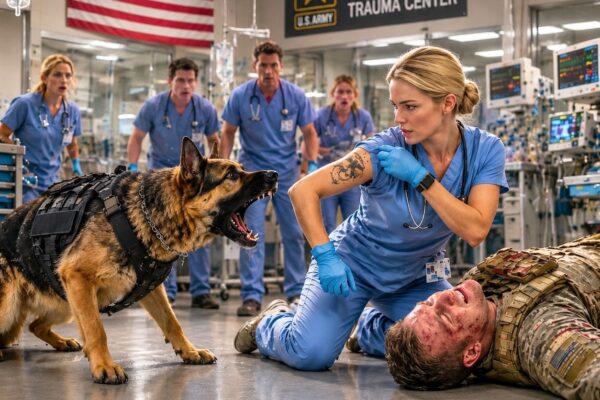
The dog suddenly broke away.
He ran across the field toward me.
Before anyone could react, the other six dogs followed.
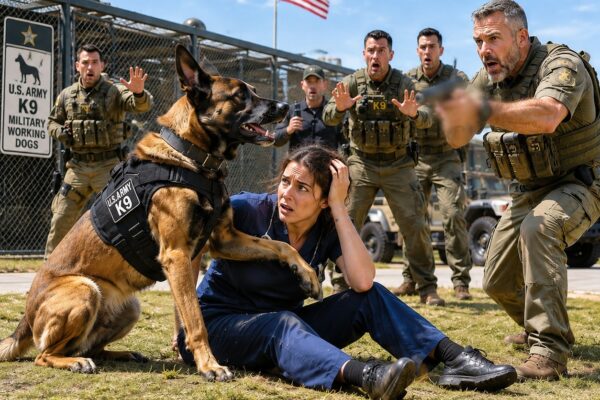
Their handlers shouted. Security officers moved toward the formation. People stood up, some screaming as the animals rushed through the crowd.
I turned.
Ranger was coming straight toward me.
For half a second, I thought he might attack.
Instead, he slammed his body against my legs and buried his head against my stomach.
He was trembling.
His tail moved so violently that his entire back end shook.
“Oh, my God,” someone whispered.
The other six dogs surrounded me.
One sat beside my boots. Another pressed its head against my hand. Two more whined and circled my legs.
I slowly lowered myself.
“Easy, boy.”
Ranger looked up.
I leaned toward his ear and whispered four words.
“Easy, Doc. I’m here.”
His trembling stopped.
He sat directly in front of me.
One by one, the other six dogs settled down.
Three hundred people fell silent.
Staff Sergeant Pruitt stared at his dog.
“I don’t understand,” he whispered. “He’s never done anything like this.”
A security officer approached with his hand near his weapon.
“Ma’am, step away from the animals.”
“Don’t pull them,” I said firmly. “You’ll frighten them. Someone could get hurt.”
My voice had changed.
It was the voice I hadn’t used in five years.
The voice of someone who had once been responsible for keeping soldiers and working dogs alive under fire.
Colonel Hargrove came down from the stage.
“What happened here?”
Pruitt explained that all seven dogs had abandoned formation simultaneously.
The colonel looked at me.
“Miss, what’s your name?”
“Rachel Bennett.”
“Do you know these animals?”
I looked down at Ranger.
“I knew this one.”
“Where?”
I hesitated.
“Five years ago. During a classified extraction operation.”
The colonel studied my face.
“What’s the meaning of the words you whispered?”
I swallowed.
“Doc was the call sign of Captain Elena Vasquez. She was a combat medic. She died five years ago.”
The colonel’s expression changed.
“Are you telling me you served with her?”
“Yes, sir. I was there when she died.”
“Under what capacity?”
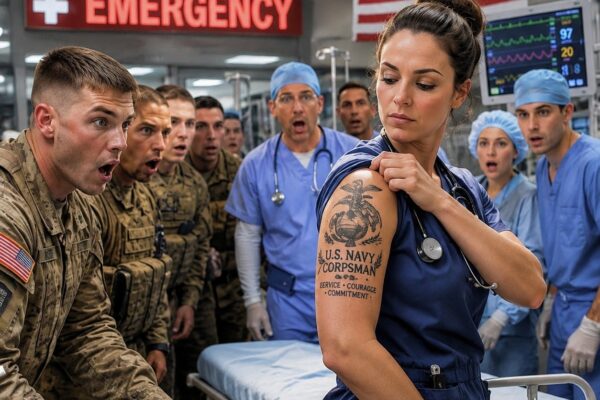
“Combat Medical Corps. Lieutenant Rachel Bennett.”
A murmur passed through the crowd.
Denise stepped forward.
“Colonel, with respect, she wasn’t even registered for this section. We should probably remove her and—”
“Denise, stop.”
His voice was quiet, but nobody interrupted again.
He turned toward Pruitt.
“Pull Ranger’s complete deployment record. I want every previous assignment, every handler, and every transfer.”
“Yes, sir.”
“And Major Lynfield in records. Tell him to retrieve the classified extraction files from five years ago.”
Then he looked at me.
“Miss Bennett, I want you to stay.”
I glanced at Ranger.
He had placed his head against my knee.
“There’s something you need to understand, Colonel,” I said. “Whatever you find in those records, somebody worked very hard to make sure it stayed hidden.”
He narrowed his eyes.
“What exactly are you suggesting?”
“I’m saying there’s a reason this dog remembers me.”
At that moment, the colonel’s radio crackled.
Major Daniel Lynfield’s voice came through.
“Sir, I found the file.”
“And?”
“There’s a serious problem. Half the document has been redacted, and the remaining pages contain a classification authorization that doesn’t match our normal procedures.”
“Whose name is on it?”
A long silence followed.
Then Lynfield answered.
“Lieutenant Rachel Bennett, Combat Medical Corps. And, sir, there’s something else. The file was deliberately sealed under an authorization code belonging to someone who wasn’t supposed to have access to it.”
The colonel turned toward me.
“Who?”
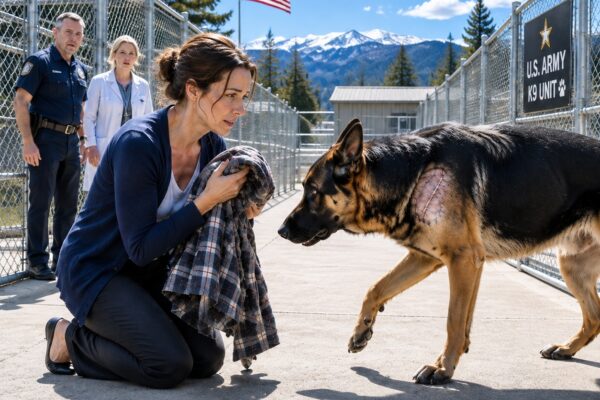
I looked down at Ranger, gently touching the old scar beneath his left foreleg.
Then I gave him a name.
“Lieutenant Colonel Howard Reyes.”
The colonel’s face went pale.
Because Reyes wasn’t just some retired officer.
He was currently working at the Pentagon.
And according to the records Major Lynfield had just uncovered, he was the very man who had approved the mission that killed Captain Elena Vasquez.
But that wasn’t the worst part.
When the colonel ordered the original records opened, someone inside the military’s classification system immediately blocked the request.
And twenty minutes later, an unauthorized user attempted to access the backup files.
Someone was already trying to destroy the evidence.
PART 2 — THE SECRET THAT FIVE YEARS COULDN’T BURY
Major Lynfield stared at his computer.
“Sir, the attempted access just succeeded.”
Colonel Hargrove stepped closer.
“What did they get?”
“Only a partial directory listing. They didn’t reach the complete files, but they searched specifically for backup locations and deletion logs.”
Inspector General representative Carla Whitfield immediately picked up her phone.
“Lock everything down. I want a forensic team here within the hour.”
I stood in the doorway, Ranger pressed against my leg.
“They’re trying to make Elena disappear again,” I said.
Hargrove turned toward me.
“Miss Bennett, I need you to understand that we’re going to handle this properly.”
“I’ve been waiting five years for someone to handle it properly, Colonel.”
He nodded.
And for the first time, I believed someone might actually listen.
Five years earlier, I had been attached to a forward medical team during an operation called Threshold Gate.
It was supposed to be a humanitarian extraction.
Two intelligence assets and their families needed to be evacuated before hostile forces could reach their location.
Captain Elena Vasquez was my partner.
She was twenty-nine, an extraordinary combat medic, and the closest thing I had to family overseas.
We worked together, trained together, and trusted each other with our lives.
During the extraction, our convoy entered a corridor that had been flagged for hostile activity.
We were ambushed.
The attack was coordinated and devastating.
Elena was hit while helping an injured K9 handler escape a damaged vehicle.
I reached her.
I tried everything I knew.
But I couldn’t save her.
Nearby, I found a military working dog with serious injuries. His handler was already dead.
The standard procedure was clear.
We were not authorized to risk additional personnel to recover an injured working dog during an active firefight.
But I couldn’t leave him.
I had already watched Elena die.
I refused to watch another life disappear if there was anything I could do.
I carried that dog approximately 1,100 meters under sustained fire until we reached the extraction point.
The dog survived.
I survived.
The two intelligence assets survived.
But Elena never came home.
And when I returned, I discovered that the official report described her death as a training accident.
The ambush didn’t exist.
The compromised route didn’t exist.
My actions didn’t exist.
I spent months trying to challenge the report. Every inquiry was delayed, rejected, or classified.
Eventually, my career was quietly pushed toward an honorable discharge.
I accepted it because I had run out of money, energy, and people willing to help.
I became a civilian nurse.
I stopped talking about the Army.
And I never learned what happened to the dog.
Until that morning.
His original name had been Doc.
His new name was Ranger.
And he had spent three years at Fort Calder without anyone telling me he was alive.
At 9:14 that evening, the unredacted documents finally arrived.
Carla Whitfield spread the pages across the records-room table.
There were three intelligence reports.
They had been filed eleven, fourteen, and forty-one days before the operation.
All three warned of hostile activity in the exact corridor through which our convoy had been routed.
All three had been reviewed by Howard Reyes.
All three had been marked:
No action required.
Whitfield looked at Colonel Hargrove.
“He had the intelligence. He knew the corridor was compromised.”
She turned another page.
“The original casualty report identifies the route selection as the primary contributing factor in the ambush.”
Then she found the final document.
The authorization sealing the casualty report.
Howard Reyes’s name appeared again.
The same man who approved the route had later used his authority to conceal the evidence.
My hands tightened.
“He knew,” I whispered.
Whitfield didn’t look away.
“The records strongly support that conclusion.”
“And Elena’s family was told she died in a training accident.”
Nobody spoke.
I had called Elena’s mother once, a year after the operation.
She had thanked me for remembering her daughter and told me the Army had explained everything.
I hadn’t had the evidence to tell her the truth.
Now I did.
But Reyes wasn’t finished.
That same night, the archive company responsible for maintaining backup military records reported something disturbing.
Someone using Reyes’s credentials had requested permanent deletion of three files connected to Threshold Gate.
The request had been submitted after he learned the investigation was underway.
Fortunately, the archive required a seventy-two-hour review period before destroying classified material.
Whitfield immediately placed the files under an official evidence hold.
“He’s just made a serious mistake,” she said. “Trying to destroy evidence after learning about an investigation gives us another avenue to pursue him.”
By midnight, Reyes’s access privileges were being reviewed.
I finally went home.
Ranger remained at Fort Calder overnight, but Staff Sergeant Pruitt told me the dog had refused to settle unless he could see the office where I had been sitting.
I barely slept.
At six the next morning, my phone rang.
It was General Diane Marsh.
“Lieutenant Bennett, I’ve reviewed the unredacted records. What happened to you and Captain Vasquez should never have happened.”
“What happens now, General?”
“Reyes’s security clearance has been suspended. He’s being placed on administrative leave. The Inspector General is opening a formal investigation.”
She paused.
“Your service record will also be reviewed.”
I thanked her.
But the situation became more complicated by lunchtime.
A defense industry website published an article suggesting that my account was unreliable.
Someone had leaked part of my old military personnel file, including a routine psychological screening I had undergone after the operation.
The article used it to imply that I had emotional problems and might be exaggerating what happened.
Whitfield called immediately.
“Someone is trying to discredit you before the investigation gains momentum.”
I stared at the article on my phone.
For five years, I had kept quiet because I believed nobody would believe me.
Now that I finally had evidence, someone was trying to make sure nobody listened.
I contacted General Marsh.
“I want to speak publicly.”
She warned me that anything I said could become part of the legal proceedings.
“I understand,” I replied. “But I’ve spent five years allowing other people to tell my story. I’m done.”
Two days later, I sat in front of a military affairs journalist.
I wore a plain dark sweater.
No uniform.
No medals.
Just the same woman who had been pushed toward the back of a parade ground.
I told the story of the ambush, Elena’s death, the injured dog, and the records that had been buried.
Near the end, the journalist asked what I wanted people to remember.
I looked directly into the camera.
“This isn’t about seven dogs recognizing me. It’s about a woman named Elena Vasquez who died doing her job. Her family was told a lie for five years. I want them to know the truth.”
The interview spread across the country.
Within hours, three former service members independently contacted investigators.
They described similar incidents involving intelligence warnings that had been ignored and reports that had disappeared after failed operations connected to Reyes’s office.
Suddenly, this wasn’t just one buried casualty report.
It was a pattern.
Eleven days after the ceremony, I appeared at a preliminary military hearing.
Reyes sat across the room with two attorneys.
He looked different from the man in his official photographs.
His confidence had weakened.
I testified for nearly three hours.
I described the operation in detail.
The route.
The ambush.
Elena.
The dog.
The decision to carry him out.
Then the investigating officer questioned Reyes.
“Did you review the three intelligence assessments warning of hostile activity in the extraction corridor?”
Reyes remained silent.
His attorney objected.
The objection was overruled.
Finally, Reyes answered.
“Yes. I reviewed them.”
“Did you decide not to reroute the convoy?”
“Yes.”
“After Captain Vasquez died, did you correct the original intelligence assessment?”
“No.”
“Did you authorize the casualty report to be sealed?”
Another long silence.
“Yes.”
“Why?”
Reyes looked down at the table.
Then he said something that changed the entire hearing.
“Because admitting the corridor decision contributed to her death meant admitting I had made the wrong call. At that point in my career, I believed it would end everything I had worked for.”
The investigating officer continued.
“And Lieutenant Bennett’s discharge process?”
Reyes’s expression tightened.
“She was the only person who knew the full sequence outside classified channels. Easing her out quietly seemed like the cleaner solution.”
Cleaner.
That was the word he used.
Not fair.
Not necessary.
Cleaner.
As if removing a woman from the Army could somehow remove the death of her closest friend.
The investigating officer recommended a full court-martial that afternoon.
Reyes faced allegations involving dereliction of duty, obstruction, and conduct unbecoming an officer. Further review would determine whether the original intelligence failure warranted additional criminal proceedings.
His clearance was revoked.
His administrative separation process began.
And for the first time in five years, the truth was officially part of the record.
Outside the hearing facility, Whitfield approached me.
“There’s something you should know.”
I turned toward her.
“Elena’s family has been contacted. They’ll receive the corrected report, an official apology, and a posthumous commendation recognizing the actual circumstances of her death.”
I couldn’t speak.
Then she handed me another document.
“Your discharge record has also been corrected.”
I opened it.
My service history had finally been restored.
My role in Threshold Gate was formally acknowledged, including the recovery of the wounded military working dog under enemy fire.
For five years, I had wondered whether anyone would ever write down what had really happened.
Now it was there.
In black and white.
Whitfield smiled.
“Colonel Hargrove wants a proper ceremony. One that recognizes your service and Elena’s sacrifice.”
I looked toward the parking lot.
Ranger was sitting in my car.
He watched me through the window.
I walked over and opened the door.
He immediately placed his head against my chest.
For a moment, I forgot about the investigation, the hearings, and the five years of silence.
I just held him.
“We made it, Doc,” I whispered.
He closed his eyes.
But there was still one loose thread.
Whitfield told me that investigators had discovered an external phone call in Reyes’s communication records.
The call had been placed shortly before the attempted deletion of the archive files.
The number belonged to a civilian contractor working inside the same regional classification office that had blocked our original request.
Someone inside that office had helped delay the investigation.
Reyes might not have been acting alone.
I handed the information to Whitfield.
She promised to investigate.
And I made myself step back.
For once, I didn’t need to carry the entire burden myself.
Several months later, Fort Calder held the ceremony.
This time, the seating arrangements were different.
The first row was reserved for Elena’s family.
Her mother sat beside her younger brother.
Colonel Hargrove stood at the podium.
I wore my restored military uniform.
Ranger walked beside me.
His muzzle had turned almost completely gray, and his movements were slower than they had been on the parade ground.
But his eyes were still bright.
The ceremony included a posthumous commendation for Captain Elena Vasquez.
Her mother held the folded flag against her chest.
When she approached me afterward, she took both my hands.
“I always wondered whether she had been afraid,” she whispered.
I swallowed.
“She was brave, ma’am. But she was human, too. She was frightened sometimes. She worried about her family. She talked about coming home.”
Her mother began crying.
Then she asked the question I had dreaded for five years.
“Did she suffer?”
I told her the truth gently.
I told her Elena had done everything she could to protect the people around her.
And I told her that she hadn’t been alone.
Her mother hugged me.
“Thank you for bringing my daughter back to us.”
I cried then.
Not because the past had suddenly become painless.
But because Elena finally had her real story back.
The following spring, I was invited to help the Army develop new procedures for reviewing classified casualty reports.
I also began training volunteers at military ceremonies.
One afternoon, a young volunteer asked me how she was supposed to know whether someone belonged in a reserved section if they arrived without identification.
I thought about Denise.
About the broken zipper on my jacket.
About how easily a person could be judged by what they appeared to be.
“You won’t always know,” I told her. “But you can ask questions without making someone feel worthless. There’s a difference between checking someone’s information and telling them they don’t belong.”
I explained that some veterans didn’t wear uniforms.
Some didn’t display medals.
Some carried memories they would never discuss.
And some simply wanted to sit quietly and remember people they had lost.
The young volunteer nodded.
I hoped she would remember.
As for Denise, she eventually sent me an apology.
I accepted it.
Not because what she had done was harmless, but because I had learned that carrying anger forever only gave the past another way to control my life.
Ranger stayed with me.
His health gradually declined, as happens with aging working dogs. I moved into a ground-floor apartment to make things easier for him and adjusted my nursing schedule.
We spent more time outdoors.
Sometimes I took him to the lake, where he would stand at the water’s edge and watch the waves.
He no longer needed to work.
He didn’t need to follow commands or protect anyone.
He had earned the right to rest.
One afternoon, I sat beside him on the sand and rubbed his gray muzzle.
“You know something, Doc?” I whispered. “You gave me back more than I ever gave you.”
He leaned his head against my leg.
I thought about the morning he had broken formation.
Seven dogs had recognized someone the entire crowd had overlooked.
A woman without a uniform.
A woman with no visible medals.
A woman whom a volunteer had decided didn’t belong.
But Ranger remembered.
He remembered the hands that had carried him through gunfire.
He remembered the person who refused to leave him behind.
And that memory had reopened a file, exposed a lie, restored a dead soldier’s honor, and given an entire family the truth they had been denied.
Two years after that ceremony, Colonel Hargrove stood beside me at the memorial where Elena’s name had finally been engraved.
He watched Ranger slowly walk around the flowers.
“I still think about that day,” he said. “If I hadn’t stopped the ceremony, if I’d simply ordered security to pull those dogs away, we might never have discovered any of this.”
I looked at him.
“But you did stop.”
“Because someone had to ask the next question.”
I smiled faintly.
“That’s all it took.”
“No,” he said. “It took seven dogs who refused to forget.”
I knelt beside Ranger.
His old eyes met mine.
I touched the scar beneath his left foreleg, the same scar I had recognized on the parade ground.
“Come on, Doc,” I whispered.
He rested his head against my hand.
Then I looked toward Elena’s name on the memorial.
“We did good,” I said.
And for the first time in five years, I no longer felt like the woman who had been pushed toward the back of the crowd.
I was Rachel Bennett.
I had served.
I had survived.
I had lost someone I loved.
And I had finally told the truth.
The Army had changed Ranger’s name, erased my service, and buried Elena’s death. But it had forgotten one thing: the people who truly love you don’t always need records to remember who you are. Sometimes, they only need one chance to find you again.