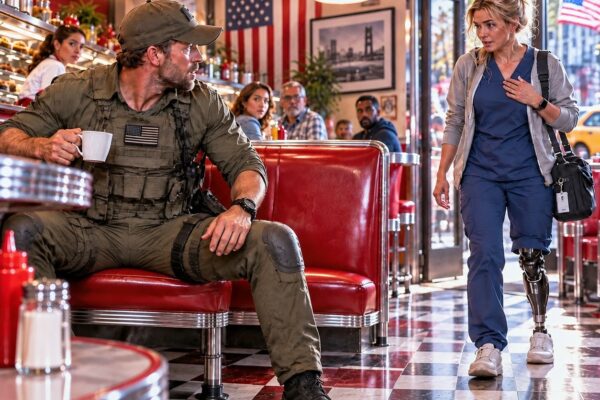
The SEAL Police Dog Trusted No One — Until the Nurse Showed Her Tattoo and Spoke One Command
PART 1 — THE WOMAN WHO KNEW THE DOG’S LANGUAGE
The helicopter landed hard enough to shake the hospital rooftop.
When its doors opened, everyone expected to see another wounded soldier.
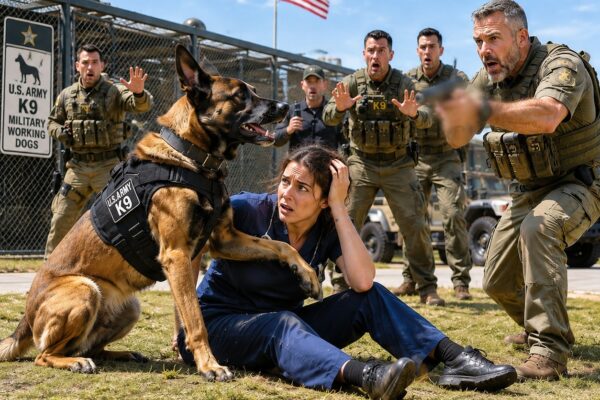
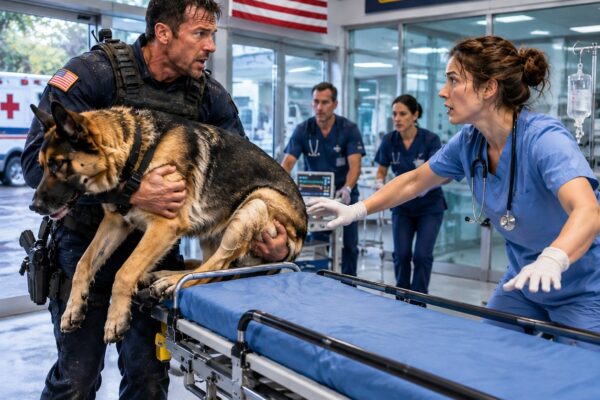
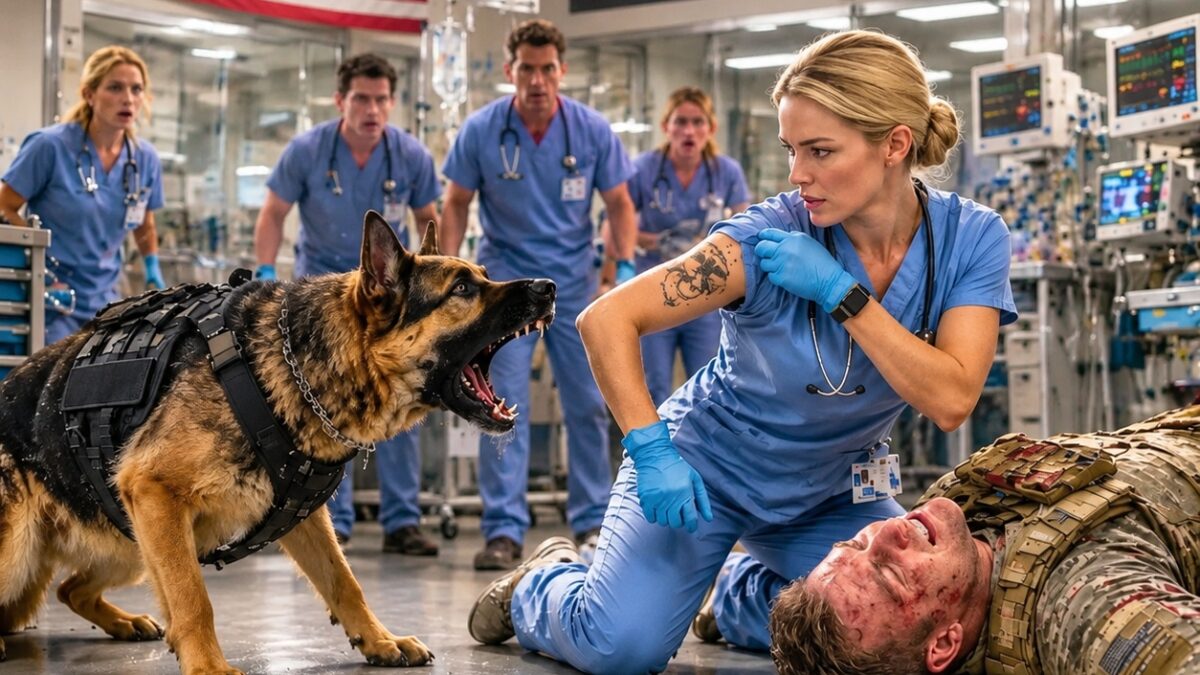
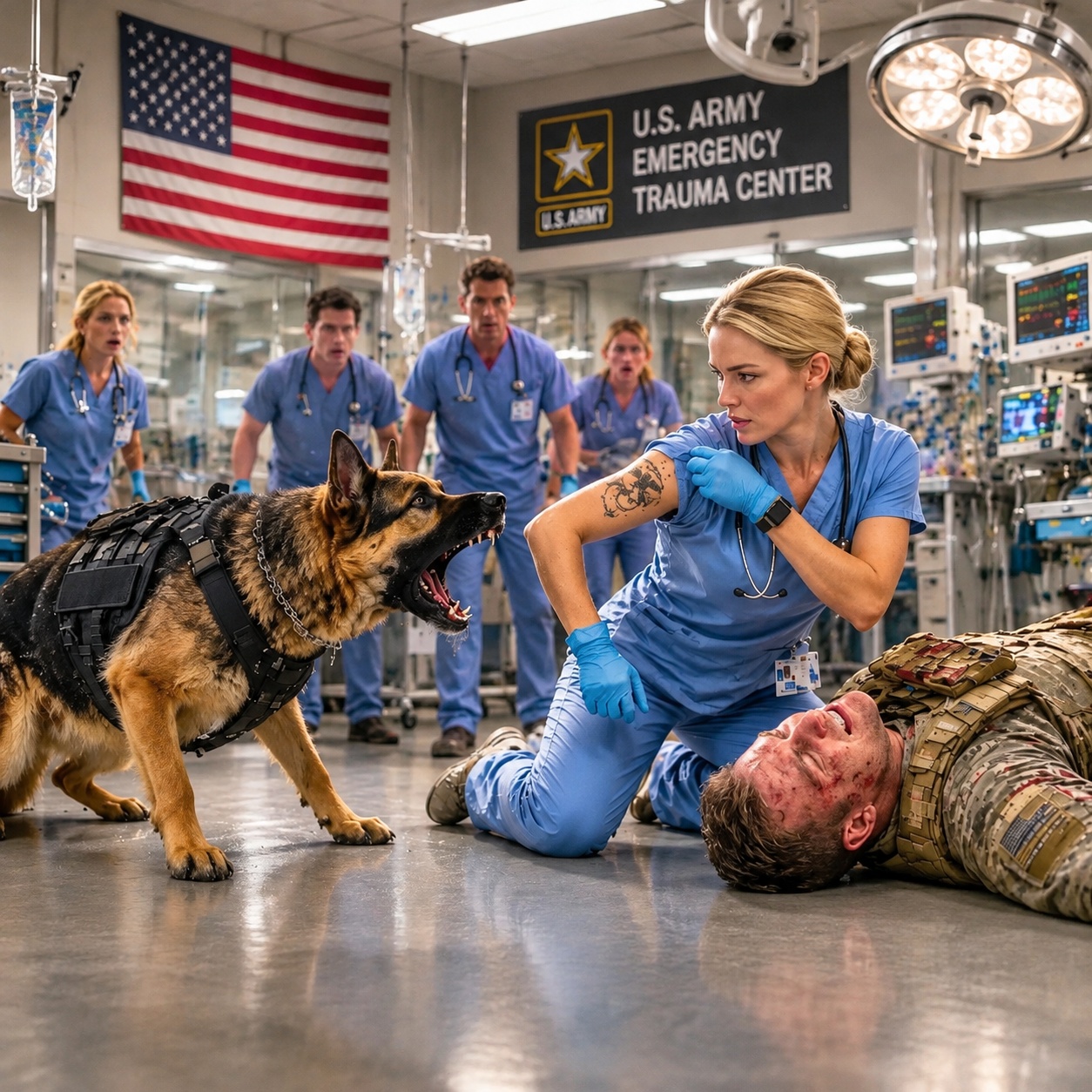
Instead, they saw a 90-pound Belgian Malinois standing over an unconscious man, his teeth exposed and his body positioned like a shield.
Three nurses backed toward the stairwell.
A security officer raised his tranquilizer rifle.
“Get that animal away from the patient!” Dr. Nathan Brooks shouted. “We don’t have time for this!”
The soldier’s blood pressure was collapsing. He had a chest wound, a badly injured leg, and a deep cut above his ear.
Then a quiet nurse stepped out of the crowd.
“I’ll handle him.”
Someone laughed.
Nobody knew that the woman they considered the least remarkable nurse in the hospital had once worked alongside military K-9 teams in some of the most dangerous places in the world.
My name is Olivia Hayes. I was thirty-one years old, and eleven days earlier, I had transferred to Redstone Regional Medical Center in Montana.
I hadn’t come looking for recognition.
In fact, I had spent the previous two years doing everything possible to avoid it.
My coworkers considered me distant. I rarely joined them after work, didn’t talk much about my past, and never volunteered information about my military service.
Deborah Mack, one of the senior nurses, had once described me as talented but difficult.
She wasn’t entirely wrong.
I had learned that explaining yourself to people who had already decided who you were rarely changed anything.
But that morning, everything changed.
The dog’s name was Rook.
The transport manifest identified him as a six-year-old military working dog assigned to Sergeant First Class Damon Voss of a Special Forces team.
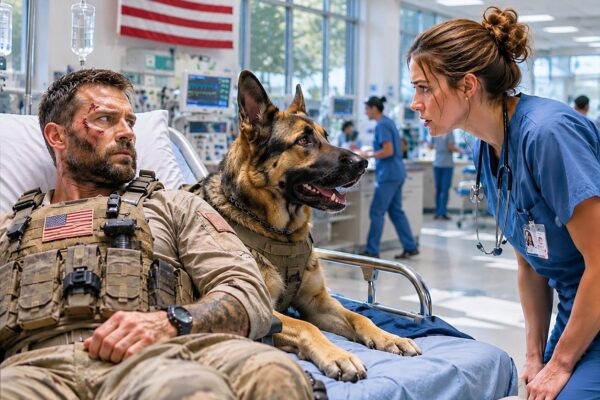
Voss lay unconscious on the stretcher.
I could see the blood soaking through his uniform. His breathing was shallow, and the pressure on his injured leg was no longer enough to control the bleeding.
Rook stood over him, refusing to let anyone approach.
“Animal control is twelve minutes away!” someone shouted.
“Then use the tranquilizer rifle!”
“Sir, if the dart misses, it could hit the patient.”
“Then don’t miss!”
I looked at the dog.
He wasn’t trying to attack anyone.
His ears were flattened. His muscles were rigid. His weight was shifted forward over his handler’s chest.
He was terrified.
But he was also doing exactly what he’d been trained to do: protect the person he trusted most.
I stepped past the gurney.
“Nurse, stop!” Dr. Brooks shouted.
I kept walking.
Rook noticed me immediately.
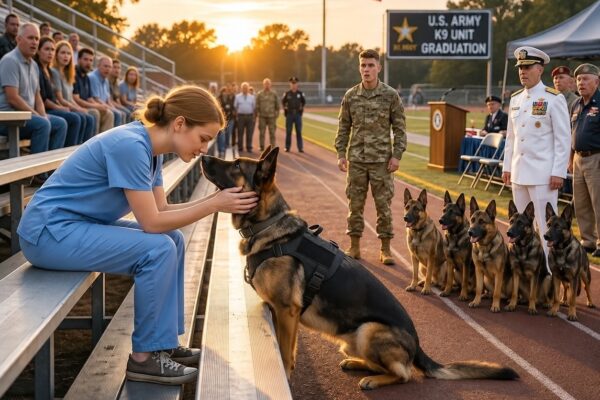
I lowered my head slightly, kept my hands open, and avoided staring directly into his eyes.
Then I spoke two words.
“Platz. Bleib.”
Sit. Stay.
The commands were in German, the language commonly used in military working-dog training.
Rook’s ears moved.
His growl weakened.
I took another step and crouched.
“Easy, boy.”
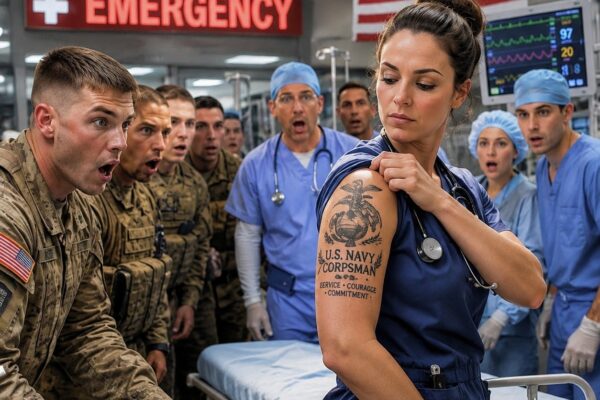
I slowly rolled up my left sleeve.
A faded military K-9 unit tattoo was visible on my wrist.
Rook approached.
He sniffed my hand.
Then, almost unbelievably, he sat down.
The entire rooftop fell silent.
I placed one hand gently against his neck.
“Good boy.”
He leaned toward me.
Only then did I move toward Voss.
Two fingers against his neck.
A pulse.
Weak, but present.
“Forty-four beats. We need to move him now!”
Nobody hesitated this time.
The gurney rolled toward the elevator, with Rook running alongside it.
Inside Trauma Bay One, I immediately helped the team assess the injuries.
“Possible pneumothorax on the left,” I told the physician. “We need imaging and immediate surgical evaluation.”
Dr. Brooks glanced at me.
“How did you recognize that?”
“Experience.”
The portable X-ray confirmed a partial lung collapse.
Voss also needed emergency vascular surgery for his leg injury.
While the surgical team prepared, Deborah Mack approached with her tablet.
“You’re not authorized to change the laboratory schedule.”
“I know,” I answered. “But his blood work needs to be prioritized.”
“We have protocols.”
“The protocol is to keep the patient alive.”
Her expression hardened.
I turned back toward Voss.
I wasn’t interested in winning an argument.
I wanted him to survive.
At 9:41 that morning, Voss went into surgery.
Rook waited outside the operating suite.
Someone brought him water, but he barely touched it.
I sat several feet away.
“He’s in good hands,” I told him.
I didn’t promise everything would be fine.
I had learned never to make promises I couldn’t guarantee.
At 1:17 p.m., the surgeon finally came out.
The vascular repair had held. The chest injury had been treated, and Voss was being transferred to intensive care.
He was alive.
Rook stood immediately when the gurney passed.
He followed until the ICU doors closed, then returned to his position outside the room.
I watched him settle beside the glass partition.
Something about that dog reminded me of a life I had spent years trying to forget.
Before becoming a nurse, I had served in the military as a combat medical specialist attached to a Special Operations K-9 unit.
I had worked with handlers, trained alongside military dogs, and helped wounded personnel survive until evacuation.
Three years of deployments had taught me things I never discussed with civilian coworkers.
But the last operation had changed me.
A teammate had died during an extraction, and I had spent months replaying every decision.
Eventually, I left active service.
I thought nursing would give me a quieter life.
I hadn’t expected the past to find me through a six-year-old Belgian Malinois.
At the end of my shift, Deborah appeared in the locker-room doorway.
“There’s something you should know.”
I closed my locker.
“What?”
“Two military investigators are here. They’re asking about the soldier and the dog.”
I walked to the conference room.
A man named Warren Cole introduced himself as a federal investigator. Beside him stood Captain Dana Rourke from Army counterintelligence.
They didn’t call me Nurse Hayes.
They called me Lieutenant Hayes.
That was when I realized they had already found my military records.
“We know your service history,” Cole said. “We also know Sergeant Voss wasn’t supposed to arrive at this hospital.”
“Why not?”
“His original destination was another military medical facility. The helicopter changed course because his condition deteriorated.”
He opened a folder.
“Eight hours before he arrived, his five teammates were killed in what was reported as a training accident.”
I stared at him.
“Reported?”
“Someone deliberately detonated an explosive device along their route.”
My stomach tightened.
“And Voss?”
“He’s the only surviving member of the team. Rook is the only other living witness.”
Captain Rourke leaned forward.
“We believe the dog may recognize the person responsible.”
I looked through the conference-room window.
Rook was still lying outside Voss’s ICU room.
“You’re not taking him away from his handler,” I said.
“We have procedures.”
“And I have medical experience. Voss has a concussion, has just undergone surgery, and is still critical. Separating them could seriously destabilize his recovery.”
Cole studied me.
“We need your help.”
I hesitated.
Then I agreed to remain with the patient and the dog while the investigation continued.
That night, I stayed beside the ICU.
At 11:48 p.m., Cole sent me a message.
Second device recovered. Remote detonation confirmed.
I read it twice.
This wasn’t an accident.
Someone had known exactly where Voss’s team would be.
Someone had arranged their deaths.
And that person might have access to the hospital.
At 12:20 a.m., I noticed a man in medical scrubs pushing a medication cart down the ICU corridor.
I didn’t recognize him.
He claimed he was checking a patient in Room 14.
But his attention kept drifting toward Voss’s room.
I stood.
“Which patient are you looking for?”
He showed me his tablet.
Something about his answer felt wrong.
“I’ll walk with you,” I said.
He stopped for half a second.
Then continued.
I watched his right hand disappear into his pocket.
“What’s in your pocket?”
He turned toward me.
His expression wasn’t frightened.
It was calculating.
Then he suddenly moved toward Voss’s room.
I shoved the medication cart sideways, blocking his path.
Rook erupted into a single, thunderous bark.
A military police officer appeared from the doorway opposite Voss’s room.
The man was arrested.
Inside his pocket, investigators found a syringe containing concentrated potassium chloride.
Someone had sent him to kill Voss.
And when investigators traced his communications, they discovered something even more disturbing.
The last message on his phone had been sent to an account connected to a senior Army officer.
A name I remembered from years earlier.
Colonel Marcus Hail.
I had once overheard him discussing suspicious military supply discrepancies during one of my deployments.
At the time, I hadn’t been senior enough to investigate.
But I had written a small note in my personnel records.
Now, someone was trying to silence the only surviving witness.
At 9:00 the following morning, Voss finally regained consciousness.
He looked through the glass and found Rook.
Then he looked at me.
“Who are you?”
“Olivia Hayes. Former military medical specialist. K-9 unit attachment.”
He studied my face.
Then I told him what had happened to his team.
His expression became completely still.
Five men were dead.
Five men he had trained with, eaten with, and trusted.
After a long silence, he asked one question.
“Who’s running the investigation?”
I told him.
“Colonel Marcus Hail.”
Voss’s eyes changed.
He looked toward the ceiling.
Then he whispered something that made my blood run cold.
“Hail knew every route we took. He approved every deployment. If he’s running this investigation, we’re all in danger.”
Before I could answer, the storm outside finally broke.
Lightning struck somewhere beyond the hospital.
The lights flickered.
And at the far end of the ICU corridor, the locked fire door slowly began to open.
Two men stepped through.
One wore an orderly’s uniform.
The other wore civilian clothes.
Rook was on his feet before either man reached the nurses’ station.
And I realized they hadn’t come to threaten Voss anymore.
They had come to finish what they started.
PART 2 — THE COLONEL WHO THOUGHT HE COULD BURY THE TRUTH
“Stop!” I shouted.
The man in the orderly’s uniform reached inside his jacket.
Before he could pull anything out, the military police officer assigned to Voss’s room stepped into the corridor.
“Hands where I can see them!”
For two seconds, nobody moved.
Then the man drew a weapon.
The officer reacted immediately.
Rook launched himself forward, striking the armed man and knocking him off balance. A shot rang through the corridor, hitting the ceiling.
The officer brought the attacker to the floor.
But the second man was already running.
I watched him disappear through the stairwell door.
My first instinct was to stay with Voss.
My second was that the man wasn’t running randomly.
He was heading toward the administrative floor, where patient transfer records and security documents were stored.
I followed.
I took the stairs two at a time, ignoring the pain in my knee.
By the time I reached the first floor, the man was running toward the east exit.
I pushed through the door.
Rain struck my face.
And there, beneath the covered walkway, stood Colonel Marcus Hail.
He was wearing a perfectly pressed uniform beneath a dark raincoat.
His expression was calm.
Too calm.
“Lieutenant Hayes,” he said.
His right hand was inside his jacket.
I stopped several feet away.
“Colonel.”
“You should have stayed a nurse.”
I looked at him.
“I was a nurse before I became a problem for you.”
His expression barely changed.
The second man stood several feet to my left.
I understood immediately.
Hail wasn’t trying to escape.
He was waiting for me.
“You arranged the attack on Voss’s team,” I said.
He tilted his head.
“That’s a serious accusation.”
“You knew their routes. You controlled the deployment approvals. You knew where they would be.”
“You’re relying on the word of an injured soldier.”
“And the communications records. And the man we caught in the ICU. And the financial trail connected to your procurement contracts.”
For the first time, his expression changed.
It was small.
But I saw it.
“You have no idea how much money and influence you’re challenging.”
“I don’t care.”
“You should.”
His hand moved inside his jacket.
I moved first.
I closed the distance, caught his wrist, and forced his arm away from his body.
A handgun slipped from his jacket.
The second man rushed toward me.
I dropped low, causing him to miss, then drove my elbow into his side.
He stumbled against the door.
Hail tried to recover his balance.
I used his own momentum to push him against the concrete wall.
The weapon hit the ground.
I kicked it away.
For a moment, both men were still.
Then the hospital door opened.
Warren Cole appeared with two federal agents.
“Federal agents! Nobody move!”
Hail looked at me.
There was no longer any confidence in his expression.
Only anger.
Cole stepped forward and secured him.
“Colonel Marcus Hail, you’re being detained pending formal charges.”
Hail didn’t resist.
He simply stared at me.
“You should have stayed a nurse,” he repeated.
I straightened my jacket.
“I was always more than that. You just weren’t paying attention.”
The investigation uncovered a conspiracy much larger than anyone initially suspected.
Hail had been working with two active-duty officers and a network of defense contractors to divert military equipment into private channels.
The operation had generated tens of millions of dollars.
Voss’s team had been investigating the trafficking network.
They had discovered that the equipment was being moved through shell companies and falsified procurement records.
The team was getting too close.
Hail had used his authority to obtain their routes and operational schedules.
Then he arranged the remote detonation.
Five soldiers died.
Voss survived only because the explosion threw him away from the worst of the blast.
Rook stayed beside him.
And when the helicopter changed course, the dog refused to leave his handler.
That decision brought them to Redstone Regional.
It also brought them to me.
Investigators recovered financial records, encrypted messages, and communications connecting Hail to the men who had attempted to kill Voss.
My old personnel note became important evidence.
It showed that I had noticed suspicious supply discrepancies years before the investigation began.
I hadn’t known what they meant.
But I had recorded them.
That small document helped establish that the corruption had been operating long before Voss’s team discovered it.
Hail’s arrest led to additional arrests across several military offices and private companies.
The case took months.
I was interviewed repeatedly.
I provided testimony about the hospital attacks, the attempted murder, and my earlier observations.
Through it all, one thing remained important to me.
The five soldiers who had died deserved to have their names remembered.
Their names were Sergeant First Class Miguel Rios, Staff Sergeant Peter Kaminsky, Sergeant Thomas Traylor, Staff Sergeant James Bennett, and Sergeant Carlos Garza.
They weren’t numbers in an investigation.
They were people.
They had families waiting for them.
And someone had deliberately taken their futures away.
Voss’s recovery was slow.
His lung injury improved, but his leg required additional treatment.
The concussion left him exhausted, and some mornings he struggled to remember conversations from the previous day.
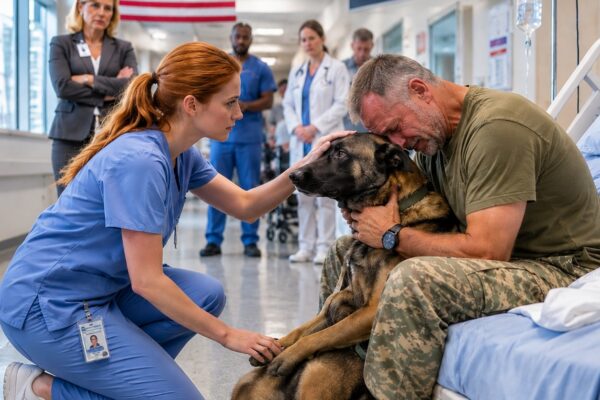
Rook never left his side.
The hospital eventually approved a special accommodation allowing the military working dog to remain with his handler during recovery.
At first, the arrangement caused administrative headaches.
Then something unexpected happened.
The nurses began looking forward to seeing Rook.
He became a familiar presence on the third floor.
He learned which staff members carried treats, which ones were afraid of large dogs, and which ones would quietly sit beside him when Voss was asleep.
He never forgot his job.
But he seemed to understand that, for the moment, protecting his handler meant allowing the doctors and nurses to do theirs.
One morning, Voss asked me to sit beside his bed.
“I owe you something,” he said.
“You don’t owe me anything.”
He shook his head.
“Five men died. I was supposed to bring them home.”
I didn’t interrupt.
“I keep thinking that if I had made a different decision, maybe they’d still be here.”
I looked at him.
“I know what that feels like.”
He studied me.
I told him about my own past.
About the operation that had ended my military career, the loss I had carried, and the years I had spent believing that leaving the service meant I had somehow abandoned the people I once worked beside.
He listened quietly.
Then he looked at Rook.
“You know what he did after the explosion?”
I shook my head.
“He searched for me. He was injured, exhausted, and surrounded by danger. But he kept coming back.”
He placed his hand on the dog’s head.
“I thought I was the one protecting him.”
His voice broke.
“Turns out, he was protecting me.”
I looked away because my eyes had filled with tears.
Some bonds didn’t need explanations.
The trial began several months later.
By then, Voss had recovered enough to attend some of the proceedings.
Rook remained with him whenever the court allowed it.
I testified over two days.
The defense attorney tried to suggest that my involvement had been accidental.
“Lieutenant Hayes, isn’t it true that you simply happened to be working at the hospital when Sergeant Voss arrived?”
“Yes,” I answered.
“You happened to be there.”
“That’s correct.”
He waited for me to elaborate.
I didn’t.
Because what he called an accident was the result of years of training, experience, and decisions that had brought me to that particular moment.
I had been there.
I had recognized the dog.
I had known what to do.
And I had refused to step aside when other people were afraid.
The jury eventually found Hail guilty on all major counts.
He was sentenced to life imprisonment.
The two officers who had helped him received lengthy prison sentences, and several members of the contractor network were also convicted.
The stolen military equipment was traced, and much of the operation was dismantled.
When I received the verdict by text, I was standing at the nurses’ station.
The message contained only one word.
Guilty.
I read it twice.
Then I put my phone down and finished my patient chart.
Justice didn’t bring five men back.
It didn’t erase what had happened.
But it meant their families would know the truth.
And that mattered.
Five weeks after the helicopter landed on our rooftop, Voss was finally discharged.
I wasn’t scheduled to work that morning, but I came to the hospital anyway.
He walked out of the recovery unit using a cane.
Rook walked beside him.
The dog looked healthier, though his attention never wandered far from his handler.
The third-floor staff had gathered in the hallway.
Kim, the charge nurse, brought coffee.
Dr. Flores stood near the elevator.
Even Dr. Brooks was there.
He approached me before Voss left.
“Hayes.”
“Doctor.”
“I owe you an apology.”
I waited.
“That morning on the rooftop, I made a decision before understanding the situation. I thought the dog was a threat. I thought you were being reckless.”
He paused.
“You were the only person who understood what was happening.”
I nodded.
“Thank you for saying that.”
He extended his hand.
I shook it.
There was no need to embarrass him or remind him of the things he had shouted that morning.
He had recognized his mistake.
That was enough.
Then Voss approached.
“The investigation will probably need me for another year,” he said.
“I know.”
He glanced toward Rook.
“And I have a feeling you’ll be hearing from him again.”
I smiled.
“He’s welcome to visit.”
Voss looked at me for a moment.
“Why did you come here, Olivia?”
I thought about the question.
“I wanted a quieter life.”
“Did you find one?”
I looked toward the ICU.
“Not exactly.”
He smiled.
“Maybe you found the right one instead.”
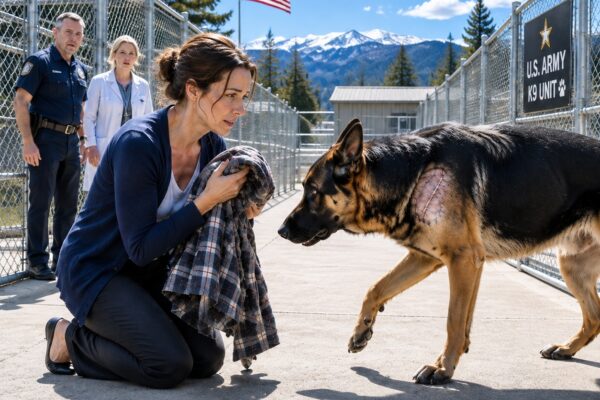
Rook approached and pressed his nose against my hand.
I scratched behind his ear.
He leaned into my palm for a few seconds.
Then he returned to his handler.
I watched them walk toward the exit.
For the first time in years, I didn’t feel like I was watching someone leave a life I had lost.
I felt like I was watching someone begin a new one.
Three weeks later, the hospital director called me into her office.
She explained that the events surrounding Voss’s arrival had exposed serious weaknesses in the hospital’s emergency procedures.
They wanted to create a new position.
A trauma coordination director who could bridge emergency medicine, military transfers, hospital security, and high-risk patient care.
They wanted someone with clinical experience and military training.
Someone who understood what happened when a medical emergency became something much bigger.
They wanted me.
I looked at her.
“You’re building this position around me?”
“Yes.”
“I have conditions.”
She smiled.
“I expected that.”
I asked for direct authority over high-risk transfer protocols, proper staffing, and a salary that reflected the responsibilities.
She agreed.
Then she said something I hadn’t expected.
“Six weeks ago, I told you this hospital owed you an apology. I don’t want to give you another sentence. I want to make an actual correction.”
I looked out the window.
The Montana mountains stood in the distance.
I thought about arriving at Redstone eleven days before that helicopter landed.
I had been tired.
I had been hiding.
I had convinced myself that the safest way to live was to make myself small enough that nobody would ever expect too much from me again.
But I had been wrong.
I didn’t need to return to the battlefield to prove I was still capable.
I didn’t need to erase my past to build a future.
I just needed to stop treating my experience as something I should be ashamed of.
“I’ll take the position,” I said.
On my first day in the new role, I arrived early.
The hospital was quiet.
I walked past the emergency department and stopped beside the rooftop elevator.
I remembered the helicopter landing.
The frightened nurses.
The raised tranquilizer rifle.
The wounded soldier.
And the dog who had refused to abandon him.
My phone vibrated.
A message from Voss.
Rook says hello. We’re doing well. He’s still looking for you whenever we visit the base.
A photograph followed.
Rook was sitting beside Voss, his ears alert and his eyes fixed on the camera.
I smiled.
Then I looked down at the faded tattoo on my wrist.
For years, I had covered it because I thought it belonged to a life that was over.
Now I understood something different.
It wasn’t a reminder of who I had lost.
It was a reminder of what I had learned, who I had helped, and what I was still capable of doing.
I pulled my sleeve back.
Then I walked into the emergency department.
There would always be another patient.
Another frightened family.
Another difficult decision.
And somewhere, there would always be someone who needed another person to step forward when everyone else stepped back.
I had spent years believing that courage meant never being afraid.
Now I knew better.
Courage was walking toward a frightened dog when everyone else reached for a weapon.
It was standing beside a wounded soldier when the truth was too painful to hear.
It was confronting a powerful man when he believed nobody would ever challenge him.
And sometimes, it was simply refusing to disappear.
I was still a nurse.
I was still a soldier in some ways.
And I was finally at peace with being both.
Because the greatest thing I had learned wasn’t how to command a military dog, save a wounded soldier, or expose a corrupt colonel. It was that leaving the battlefield doesn’t mean leaving behind the strength that carried you through it. Sometimes, the next life you save begins with the decision to stop hiding your own.