THE POLICE DEPARTMENT CALLED MY HUSBAND’S K-9 PARTNER A DANGEROUS, BROKEN ANIMAL AND PLANNED TO PUT HIM DOWN—UNTIL I WALKED INTO HIS KENNEL WITH MY HUSBAND’S OLD FLANNEL SHIRT. WHAT HE DID NEXT REVEALED A SECRET THAT SOMEONE HAD KILLED MY HUSBAND TO HIDE.
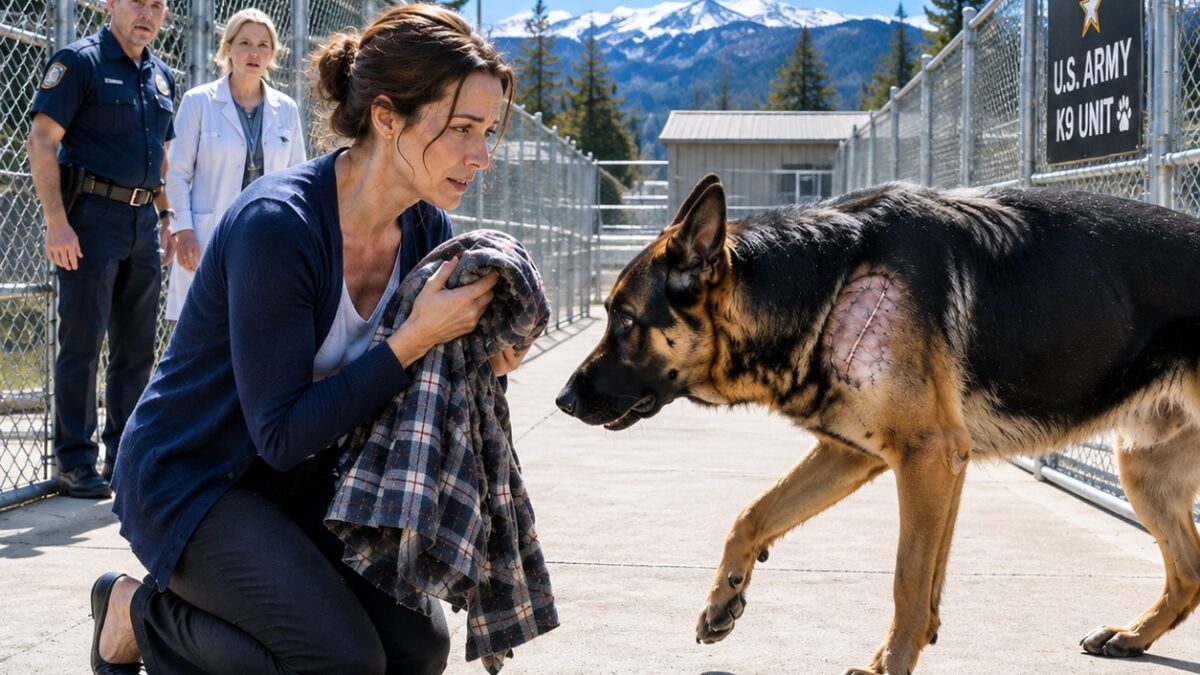
THE POLICE DEPARTMENT CALLED MY HUSBAND’S K-9 PARTNER A DANGEROUS, BROKEN ANIMAL AND PLANNED TO PUT HIM DOWN—UNTIL I WALKED INTO HIS KENNEL WITH MY HUSBAND’S OLD FLANNEL SHIRT. WHAT HE DID NEXT REVEALED A SECRET THAT SOMEONE HAD KILLED MY HUSBAND TO HIDE.
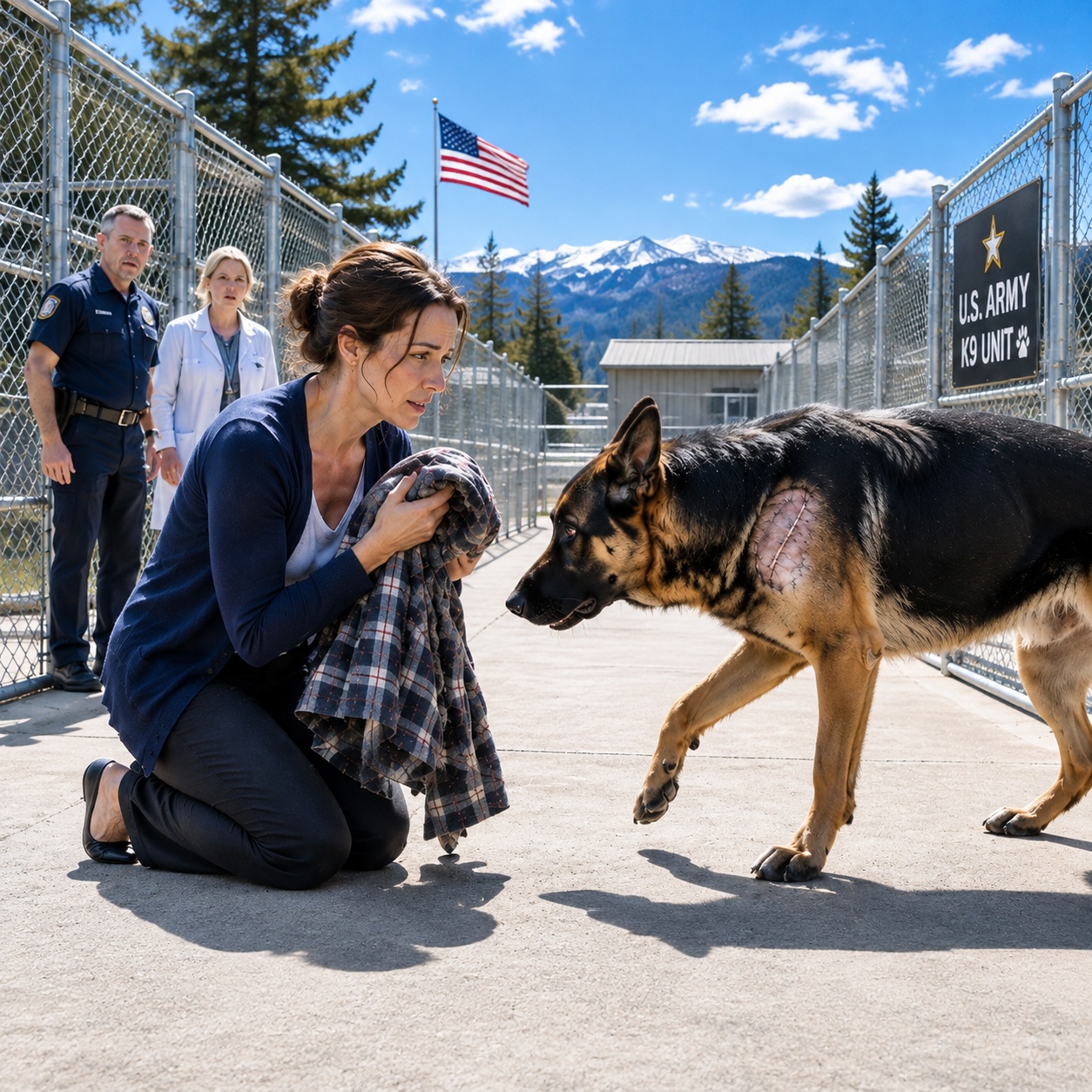
The police department had given my husband’s K-9 partner a death sentence.
They said he was too dangerous to rehabilitate, too aggressive to adopt, and too broken to ever work again.
But when I entered his kennel carrying my husband’s old shirt, the supposedly uncontrollable German Shepherd did something that made three experienced officers freeze.
And before that day was over, I would discover that my husband’s death had never been an accident.
My name is Diane Mitchell. Six months earlier, my husband, Jonathan, had been killed during a police raid at a warehouse near Portland, Oregon.
He had been a respected detective with the Portland Police Department.
His partner was Kaiser, a forty-three-kilogram German Shepherd trained in narcotics detection and suspect apprehension.
They had worked together for almost five years.
Jonathan used to tell me that Kaiser understood him better than most people did. He could recognize the slightest change in Jonathan’s breathing, anticipate hand signals, and respond to commands before other officers even understood what was happening.
At home, however, Kaiser was completely different.
He stole socks from the laundry basket, slept beside Jonathan’s boots, and insisted on resting his enormous head across my husband’s feet every Sunday morning.
He was part of our family.
Then came the night everything ended.
Jonathan and Kaiser were assigned to a raid at an industrial warehouse suspected of being used by a criminal smuggling organization.
The operation was supposed to be routine.
It wasn’t.
The warehouse had been rigged with explosives.
When Jonathan and Kaiser entered through a rear access door, a concealed tripwire triggered a devastating blast.
Kaiser was thrown several yards across the concrete floor.
Jonathan instinctively moved between the explosion and his partner.
He absorbed the worst of the blast.
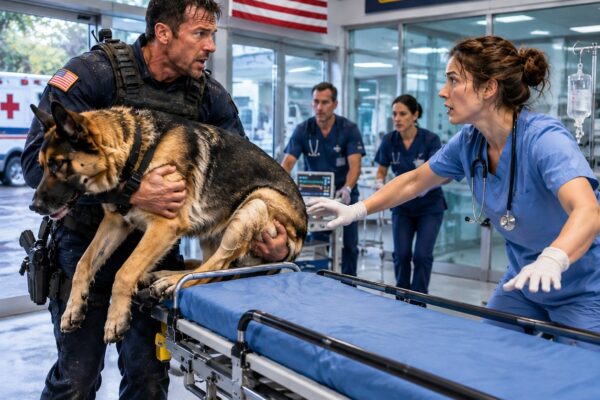
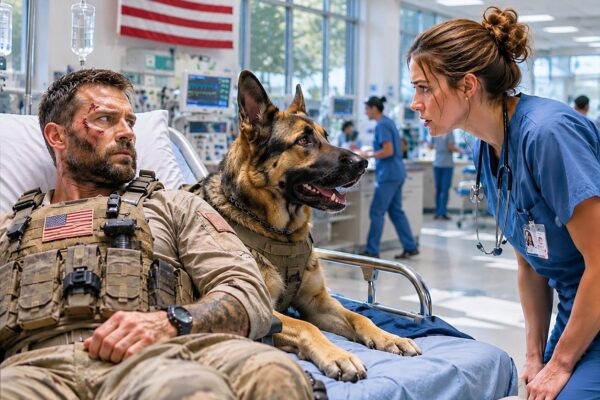
By the time rescue personnel reached them, Jonathan was dead.
Kaiser was found standing over his body, refusing to let anyone approach.
It took three officers wearing protective equipment to pull him away.
He survived, but something inside him had disappeared.
The confident, affectionate dog I knew became a frightened, unpredictable animal.
He stopped responding to familiar commands.
He barely ate.
He spent hours staring at concrete walls, occasionally growling at shadows that nobody else could see.
The department sent him to the Oakridge K-9 Rehabilitation Center in Oregon.
They assigned him to Sergeant Paul Miller, an experienced handler who had successfully rehabilitated dozens of police dogs.
Paul lasted three days.
Kaiser attacked him during a training session, leaving him with serious injuries to his arm.
Two other handlers were subsequently injured.
After that, the department classified Kaiser as a severe public-safety risk.
Dr. Emily Vogt, the facility’s veterinary behavior specialist, diagnosed him with severe trauma-related behavioral problems.
She believed he was trapped in the memory of the warehouse explosion.
But the department was running out of patience.
One afternoon, Police Captain Robert Hayes placed an authorization form on his desk.
It approved Kaiser’s euthanasia.
He was scheduled to be put down that Friday.
Captain Hayes later told me that the decision had been one of the most difficult of his career.
I believe he meant it.
But he also knew the department couldn’t risk another officer being seriously injured.
He had already lost one decorated officer.
He wasn’t willing to lose another.
Then he remembered me.
And he decided I deserved the opportunity to say goodbye.
When Captain Hayes arrived at my house, I was sitting in the living room staring at Jonathan’s old coffee mug.
His boots were still beside the back door.
His favorite flannel shirt was hanging in the closet.
I hadn’t moved any of his belongings.
I couldn’t.
The captain explained everything about Kaiser.
The failed rehabilitation.
The attacks.
The decision.
When he finished, I stared at my hands.
“You’re saying he’s going to die, too?”
Captain Hayes lowered his eyes.
“I’m afraid that’s where things stand.”
I shook my head.
“He isn’t a dangerous animal, Robert. He’s grieving.”
“Diane, you need to understand that he has injured trained professionals.”
“So did Jonathan, sometimes, when he was fighting to protect someone.”
The captain sighed.
“I thought you might want to visit him one last time.”
I stood up.
“Take me to him.”
The drive to Oakridge was silent.
When we arrived, Sergeant Miller and Dr. Vogt were waiting.
They explained the safety precautions.
Kaiser would be wearing a reinforced muzzle. I wasn’t supposed to make sudden movements or attempt to touch him.
If they told me to step away, I had to obey immediately.
I agreed.
Then they led me down a long corridor.
Kennel Four was at the end.
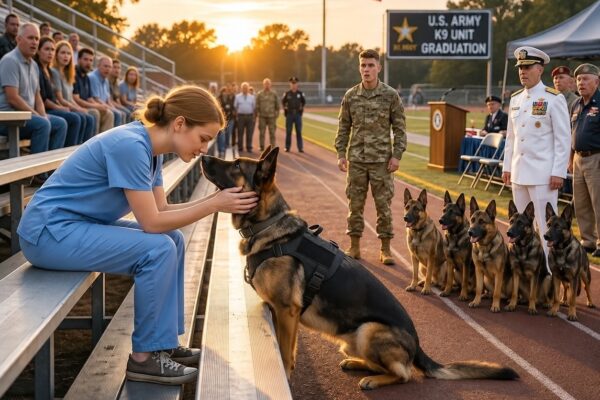
When I saw Kaiser, my heart nearly broke.
He had lost weight.
His black-and-tan coat looked dull, and a long scar crossed his left shoulder.
He was lying in the corner, staring at the concrete wall.
When he heard our footsteps, he slowly raised his head.
A deep growl rolled from his chest.
Sergeant Miller moved between us.
“Stay back, Mrs. Mitchell.”
But I couldn’t take my eyes off him.
That wasn’t the dog I remembered.
That was a creature who had lost the only person he trusted.
I opened my canvas bag.
Inside was Jonathan’s old gray flannel shirt.
I had washed it once after the funeral, but I had never been able to put it away.
I slowly lowered myself onto the cold concrete floor.
Kaiser growled louder.
Behind the fence, Dr. Vogt whispered that I was making a mistake.
I ignored her.
I unfolded the shirt and placed it in my lap.
“Hello, sweetheart.”
Kaiser’s ears moved.
I began crying.
“The department thinks you’ve forgotten everything Jonathan taught you.”
He took one hesitant step forward.
“But I know you haven’t.”
Another step.
I held the shirt against my chest.
“Do you remember Sunday mornings? How he used to complain when you stole his socks?”
Kaiser’s growling stopped.
I looked into his amber eyes.
“Jonathan told me something once. He said the hardest part of being a police dog wasn’t learning how to fight.”
Kaiser lowered his head.
“It was learning when the fighting was over.”
I pressed the shirt against my cheek.
Then I whispered the words my husband had used every evening when he returned home from work.
The secret command he had taught Kaiser, a command that belonged to their home and nowhere else.
“Clock out, buddy. You’re home.”
For three seconds, nothing happened.
Then the enormous German Shepherd made a sound I will never forget.
It wasn’t a growl.
It wasn’t a bark.
It was a broken, desperate whimper.
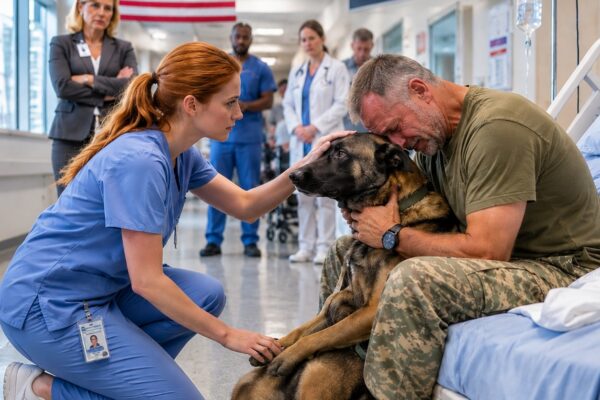
Kaiser rushed forward and collapsed against my chest.
His muzzle pressed into Jonathan’s shirt.
His entire body trembled.
I wrapped my arms around his neck and cried into his fur.
Outside the kennel, Sergeant Miller lowered his head.
Dr. Vogt covered her mouth.
For the first time in six months, Kaiser had stopped fighting.
When they carefully removed his muzzle, he didn’t bite anyone.
He simply licked the tears from my face.
That evening, Captain Hayes approved his retirement and transfer into my care.
I brought him home.
I thought the worst was finally behind us.
But that night, something happened that made me realize Jonathan had left behind more than memories.
Kaiser refused to sleep beside his old bed.
Instead, he walked down the hallway, stopped in front of the coat closet, and began scratching at the door.
When I opened it, he pushed his nose toward a sealed cardboard box containing Jonathan’s belongings recovered from the warehouse.
He wouldn’t move away.
I opened the box with trembling hands.
Inside were Jonathan’s damaged tactical vest, his broken watch, his badge, and a black metal flashlight.
Kaiser ignored everything except that flashlight.
He nudged it toward me.
Then he barked twice.
I picked it up.
It felt unusually heavy.
When I finally managed to unscrew the bottom, I discovered that the battery compartment wasn’t empty.
Hidden inside was a tightly rolled document and a small encrypted USB drive.
I unrolled the paper.
It contained financial transfers, shipping records, and several names.
One name had been circled in red ink.
Captain Robert Hayes.
Before I could understand what I was looking at, Kaiser turned toward the front door.
His entire body stiffened.
Then someone knocked.
And the voice outside belonged to the very man whose name Jonathan had hidden inside that flashlight.
” Dianne,” Captain Hayes called softly. “I forgot to give you some paperwork. Open the door.”
Kaiser began to growl.
And suddenly, I understood why my husband had hidden the evidence instead of turning it over to his own department.
PART 2 — THE SECRET MY HUSBAND DIED PROTECTING
I stood motionless in the hallway, holding the USB drive.
Kaiser positioned himself between me and the front door.
His ears were pointed forward, and his eyes never left the entrance.
Something about his behavior frightened me more than the growling.
This wasn’t the confused, frightened dog I had brought home that afternoon.
This was the trained police dog Jonathan had once trusted with his life.
“Diane?” Captain Hayes called again. “Are you there?”
I forced myself to answer.
“Just a minute. I’m getting dressed.”
I slipped the papers and USB drive into my cardigan.
Then I quietly took my car keys from the kitchen counter.
The back door led to a detached garage.
I had barely reached it when the front door shook violently.
Someone was forcing it open.
I heard wood splinter.
Then a man’s voice.
“Find the box! She has it!”
It wasn’t just Captain Hayes.
There were at least two other men inside my house.
I ran toward the garage.
“Kaiser, come!”
But he didn’t follow.
He turned toward the intruders.
For one terrifying moment, I thought I was about to lose him, too.
Then the first man entered the kitchen.
Kaiser launched himself forward.
The man fell backward, dropping his weapon as the dog pinned his arm.
The second intruder rushed toward him.
Kaiser released the first man and knocked the second off his feet.
I reached the garage, pressed the remote, and threw myself into the driver’s seat.
“Kaiser!”
The dog heard my voice.
He immediately disengaged and sprinted through the back door.
He jumped into the passenger seat just as I started the engine.
A gunshot shattered the kitchen window.
I reversed so quickly that I knocked over the garbage cans.
Then I drove into the rainy darkness.
I didn’t stop until I was several miles outside town.
My hands were shaking so badly that I could barely hold the steering wheel.
Kaiser sat beside me, watching the road.
I looked at him.
“Jonathan knew, didn’t he?”
The dog turned his head.
I began crying again.
“That’s why he never came home.”
I remembered Jonathan’s last phone call.
He had sounded unusually serious.
He told me he loved me, asked me to check the back door lock, and said something I hadn’t understood at the time.
“If anything happens, trust the dog.”
I had thought he was simply being cautious.
Now I understood.
I needed someone outside the Portland Police Department.
There was only one person I could think of.
Michael Hart, Jonathan’s former FBI mentor.
He had retired several years earlier and lived in a secluded cabin in northern Oregon.
I drove through the night.
Kaiser remained alert beside me, occasionally looking toward the rear window.
Three hours later, I reached Michael’s property.
He opened the door before I could knock twice.
When he saw my soaked clothes and Kaiser’s tense expression, he immediately stepped aside.
“Diane, what happened?”
I placed the flashlight, documents, and USB drive on his kitchen table.
“Jonathan left something behind.”
Michael put on his reading glasses.
He examined the financial records.
His expression changed.
“Where did you get this?”
“Inside his flashlight. Kaiser found it.”
Michael looked toward the dog.
Then he returned to the documents.
After several minutes, he leaned back.
“Your husband discovered a major criminal operation.”
“What kind?”
“Illegal weapons trafficking. Money laundering. Shipments moving through several ports, with payments being routed through shell companies.”
He pointed to a series of names.
“Someone inside the department was protecting the operation.”
I looked at the red circle.
“Captain Hayes.”
Michael shook his head.
“No. Look more carefully.”
I leaned forward.
The name inside the circle wasn’t Robert Hayes.
It was Gregor Mertens.
Mertens was the senior commander overseeing the unit Jonathan had worked with before his death.
Michael explained that the evidence suggested Mertens had been receiving money from the smuggling organization for years.
Jonathan had discovered the transactions while investigating suspicious shipments.
The warehouse raid had not been a routine operation.
It had been a trap.
“Do you think he arranged the explosion?” I asked.
Michael’s expression hardened.
“I think your husband found something powerful enough to make someone desperate.”
He connected the USB drive to a secure laptop.
A password screen appeared.
I stared at it helplessly.
“I don’t know the password. Jonathan never shared his investigative files with me.”
Michael tried several combinations.
Nothing worked.
Then Kaiser approached me.
He gently pressed his nose against my hand.
I looked down at him.
Suddenly, I remembered the moment inside Kennel Four.
Jonathan’s secret command.
The words that had finally reached Kaiser after six months of silence.
“Clock out.”
I turned toward Michael.
“Try ‘clockout.’ All lowercase. No space.”
He typed the word.
For a moment, nothing happened.
Then the screen changed.
Thousands of files appeared.
Bank transfers.
Photographs.
Audio recordings.
Shipping manifests.
Internal police communications.
Michael stared at the screen.
“My God.”
“What?”
He opened a folder containing recordings from the days before the warehouse raid.
One recording captured Jonathan speaking to another officer.
His voice was clear.
“I’ve got the payment records. Mertens is coordinating the shipments. I think he knows I’m close.”
Another voice responded.
“Then you need to get those records out of the department.”
Jonathan answered:
“I already have.”
Michael paused the recording.
I covered my mouth.
My husband had known he was in danger.
He had prepared for the possibility that he might never come home.
But he had also made sure the truth wouldn’t die with him.
Michael immediately contacted trusted federal investigators.
He sent copies of the files through secure channels and arranged for the original evidence to be preserved.
For the first time since Jonathan’s funeral, I felt that someone might finally be able to explain what had happened.
But the danger wasn’t over.
Two days later, federal agents arrested Gregor Mertens at his office.
Several other officers were taken into custody.
Investigators recovered financial records, weapons shipments, and communications connecting the smuggling organization to corrupt members of the department.
The evidence also revealed that the warehouse operation had been deliberately compromised.
Jonathan had been killed because he discovered the network and refused to cooperate.
The department had called his death a tragic operational failure.
Now the truth was finally coming out.
I watched the news from Michael’s cabin.
My husband’s photograph appeared on the television.
The reporter described him as an officer whose final investigation had helped expose a criminal organization operating inside the police department.
I couldn’t stop crying.
Kaiser rested his head on my knee.
I stroked his ears.
“We did it, buddy.”
For the first time, I could say those words without feeling that Jonathan’s death had been completely meaningless.
The months that followed were difficult.
I still missed Jonathan every morning.
I still sometimes reached for his coffee mug before remembering he wasn’t coming back.
But the fear that had consumed our home was gone.
Kaiser began to recover.
He gained weight.
His coat became glossy again.
He learned to sleep through thunderstorms and no longer reacted violently to every unexpected sound.
Michael helped arrange for him to receive a formal medical retirement and permanent placement with me.
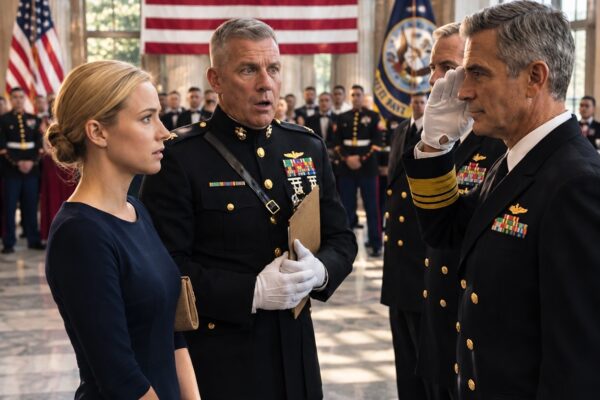
The department also honored Jonathan at a memorial ceremony.
I attended with Kaiser.
Sergeant Paul Miller was there.
He approached us slowly, kneeling several feet away.
“Hello, old friend.”
Kaiser looked at him.
For a moment, I held my breath.
Then he stepped forward and gently sniffed the man’s hand.
Paul’s eyes filled with tears.
“Jonathan would be proud of you.”
Kaiser leaned against his knee.
And I realized something.
The dog hadn’t needed another handler.
He had needed permission to stop waiting for the man he loved to come back.
Today, Kaiser lives with me in a small house outside Portland.
He has a comfortable bed beside the fireplace, a collection of tennis balls, and a favorite sunny spot on the porch.
He still occasionally wakes from nightmares.
When that happens, I sit beside him and gently rub his neck.
“Clock out, buddy,” I whisper.
“You’re home.”
His breathing gradually slows.
Sometimes I wonder what Jonathan would say if he could see us now.
He would probably laugh at how spoiled Kaiser has become.
He would probably complain that the dog still steals socks.
And he would certainly be proud that the partner who once protected him in the most dangerous places had helped protect the family he left behind.
People sometimes ask me how I found the courage to enter Kennel Four that day.
The truth is, I wasn’t brave.
I was grieving.
I saw an animal suffering the same loss I was suffering, and I couldn’t accept that the world was going to punish him for it.
The department saw a dangerous police dog.
I saw the last living connection to my husband.
And Kaiser saw someone who still smelled like home.
The greatest surprise wasn’t that he recognized Jonathan’s shirt.
It was that he remembered the one command that meant he no longer had to fight.
He had spent six months trapped inside the worst moment of his life.
That day, I finally gave him permission to leave it.
And when he led me to that flashlight, he gave me something in return.
The truth about the man I loved.
Sometimes I sit on the porch in the evening with Jonathan’s old flannel shirt folded beside me.
Kaiser rests his heavy head on my lap.
The sun disappears behind the trees, and the house grows quiet.
I look down at him and whisper the words that once brought him back from the darkness.
“Good boy, Kaiser. Your shift is over.”
His tail moves gently against the wooden floor.
And for the first time in a very long time, I know that both of us are finally home.
Because Jonathan’s last mission wasn’t simply to expose a criminal organization.
It was to make sure that even if he never returned, the two beings he loved most would still find a way to protect each other.